Sometimes it helps to go into a movie blind. Perhaps there's something to be said for having no more than the bare minimum of background information and context to hang your expectations on, at least when it comes to watching certain types of film. That was more or less my own experience of the recent sleeper hit
Iron Lung. Directed by Mark Fischbach, known also as the internet personality Markiplier, and created and developed by David Szymanski,
Iron Lung functions as a film adaptation of the indie Horror game of the same name. That was just about the extent of all I knew going into this movie. I had a few more bits of knowledge, most of which I owed to
the review of YouTube critic Ryan Hollinger. However, aside from that one note of good press, I had very little else to go on. My own experience with Markiplier, for instance, is very close to that of Hollinger. He was just one of those names you're bound to run into when looking up clips of various video games online. That's pretty much all that happened, really. Fischbach's online name and videos were tossed up by a friendly algorithm, and he remained an on-and-off presence in my search history here and there on occasion. I can't recall even watching much of his stuff in the lead-up to realizing the film had an honest to goodness theatrical release. If I'm being brutally honest with myself here, it's probably telling that my initial impression to news that Markiplier, of all people, was making a movie based on a video game, existed somewhere on a limited spectrum, one that ran from muted, to mixed, to nothing at all.
It was just another one of those bits of passing trivia that you can't help running into sooner or later, because the Web never exists in a vacuum, and stuff like this is bound to make the rounds. I think the initial coolness I had to the idea was bound up with a lot of personal experience that I'd had with movies at the time. It's no secret that Hollywood seems to be going through a creative drought period. There's a lot to complain about with the way Tinseltown has been handling both its new material and its legacy media. I'd gotten so used to not getting worked up about the latest film announcements, even if it was something I liked, that I more or less automatically assumed the same arrangement with Markiplier's efforts in his big screen debut. My overall reaction at the time was at least a bit understandable. It also turns out to have been very unfair to both of the artists involved, and I'll explain why later on in the review proper. Before we get there, however, I've since learned at least something about the nature of, as well as the context behind the making of this film and its source material. Giving newcomers at least some background information about the thinking and culture that exist behind Iron Lung can go a long way to explaining both what the movie is trying to achieve, as well as my own critical reactions to it.
In order to do that, we have to say a brief word about the true creator behind
Iron Lung, and the artistic milieu his efforts emerged from. If I knew just the bare minimum about Markiplier before I watched this film, I knew even less about David Szymanski, the video game developer who got this whole project started.
Iron Lung began its life as an indie console title that slowly became something of an overnight sensation in both Gamer and Horror circles. We'll get further into the thought Szymanski put into the game, and how that all translates to the screen in a minute. For now, it's enough to state the bare facts. Dave seems to have been a gaming enthusiast from an early age, and its a passion he shares with his brothers John and Evan, both of whom have created their own well known Horror game title with
My Friendly Neighborhood. In addition to liking video games, David seems to share an equal passion for works of Gothic Fiction, with critics like Hollinger pointing to what appears to be a clear influence of H.P. Lovecraft on the nature of
Iron Lung as both a game and film. There seems to be a bit more to it than that, yet before we dive into the movie's storytelling mechanics, there remains just one final background component to talk about, one that kind of helps establish the context of this movie.
In many ways, it helps to see
Iron Lung, whether as a game or film, as the product of a still ongoing process of creation and discovery within the modern Horror genre. I don't know how many in the audience have been keeping track of this, yet there's a process of creative and artistic experimentation that's been ongoing in field of Things that Go Bump in the Night for some time now. It seems to have got started with not just the release of
The Blair Witch Project, but also it's somewhat innovative use of viral marketing. It's been cited as the first instance of a successful ARG, or Alternate Reality Game. While it's a mistake to claim that
Blair Witch was a complete trailblazer in any of these storytelling tactics, it was the one to bring a lot of the techniques we now associate with un/fiction into a broader pop-culture awareness. It was the cultural mainstreaming of these hybrid styles of storytelling performance that allowed a slew later talents to be Inspired by the Folk Horror brainchild of Eduardo Sanchez and Daniel Myrick. It's like the makers of
Blair Witch touched a nerve in similar creative types in a way that acted as a form of giving permission, for lack of a better word. It showed indie filmmakers and artistic talents everywhere that, yes, you can realize the projects and dreams in your head. No matter how crazy or obtuse they may seem, there's an audience out there waiting for it all.
The result seems to have been one of those creative wellspring whose various elements and products are only now starting to be realized by most viewers and readers as part of a much larger, and still ongoing creative development within the realm of Horror. Thanks to the success of Blair Witch's ARG approach, there have been countless others that have followed in its wake. In the process, artists like Kris Straub and Kane Parsons have taken up the mantle set down by Sanchez and Myrick, and expanded it into the realms of the subgenre now known as Analog Horror. The fact that the format itself seems to be reaching a point of coming full circle with the successful release of The Backrooms might point to the small Renaissance started in the backwoods of Burkittsville as starting to gain some kind of further mainstream traction. In addition to the various shared breakthrough efforts featured on movie screens or the internet, it seems as if the un/fiction tropes spotlighted by the Blair Witch franchise has also managed to find its way into the realm of the written word. Starting out with a simple subreddit dedicated to telling scary stories in a style similar to that of Found Footage films, the efforts of a just a bunch of folks chilling together and entertaining one another with who can tell the best twisted tale has since morphed in The NoSleep Podcast, thanks to the efforts of creators Matt Hansen and David Cummings. Other writers like Craig Groshek have started their own Simply Scary anthologies.
The major consequences of endeavors like these have been the creation of what's often known as Creepypasta storytelling. All it amounts to is the old practice of Urban Legends transferred to the electronic, digital campfire. It's where authors like the aforementioned Kris Straub got the idea for "Candle Cove" and
the larger Analog Horror series that has spun off from it. Dave Szymanski's place in this ongoing proliferation comes from the world of video games, and the effect that this underground, New Wave Horror Boom has had on the format. The trends appears to have reached even into the gaming sphere, as we've seen Analog Horror artists Remy Abode take his
Gemini Home Entertainment series and craft an actual game set in the universe of his online ARG. The developers of an upcoming title known as
Giggleland, meanwhile, have
resorted to Analog Horror/ARG in the marketing of their product. Szymanski belongs to this same cadre of indie devs who are busy trying to see how well they can craft games that share an equal amount of art with the usual sort of entertainment that most players still expect from any halfway decent platformer. In Szymanski's case, that's meant crafting a series of dark secondary worlds beset by various types of terrors, many of which owe their Inspiration to Gothic masters of the Weird such as H.P. Lovecraft and filmmakers like Tobe Hooper.
In terms of overall game aesthetic, David tends to design his titles in an intentional kind of throwback style. His games tend to harken back to the type of visual design that was most prevalent during the early 90s, with some 80s arcade influences thrown in to the mix. He's basically a fan of the retro gamer approach to platform design. You can expect most of his output to at least look like it was designed at or around the time that, say, the original Alone in the Dark was released for Mac and PC. Iron Lung proved to be David's big breakout title, and as of this writing it still seems to be the game he's most known for. Before we proceed any further, all that remains to be said by way of introduction is that the original video game incarnation quickly became a major favorite in YouTube's endless supply of Let Play streams, with professional platform players like JackScepticEye recording their playthroughs of Szymanski's major mainstream hit. This created the kind of feedback loop you might expect, where the more internet personalities showcased them game on their Lets Plays, the more they all just served to boost Iron Lung's popularity, and sooner or later Szymanski found that he had a hit on his hands.

It was the experience of one online player in particular that seems to have started the gears in the back of his head turning, and that lead to a surprising amount of first personal, and later on an even greater deal of shared ambition and collective drive to see how a game like this could be fleshed out. All that happened was surprisingly simple, at least to start out with. Markiplier heard about the game like everyone else, and he decided to record his own playthrough, complete with the usual amount of hilarious and comedic actions that he was best known for at the time. What I don't think any of us expected was for Fischbach to be so taken with Szymanski's quasi-Lovecraftian, yet otherwise very simple platform release to the point where he soon developed the enthusiasm to see if he could turn it all into an actual, legitimate Horror film. What happened next has become something of a legend in itself. For the longest time after that initial moment of Inspiration, Markiplier was very much living an underdog story where it was just him and his friends and family chipping in to help make this dream a reality. When you go back and find out about all the heart and soul the man poured into this project, you tend to feel bad for being so dismissive in the first place. All that is getting ahead of things, however. The point is, Markiplier and Szymanski got their film made, and now here are the results.
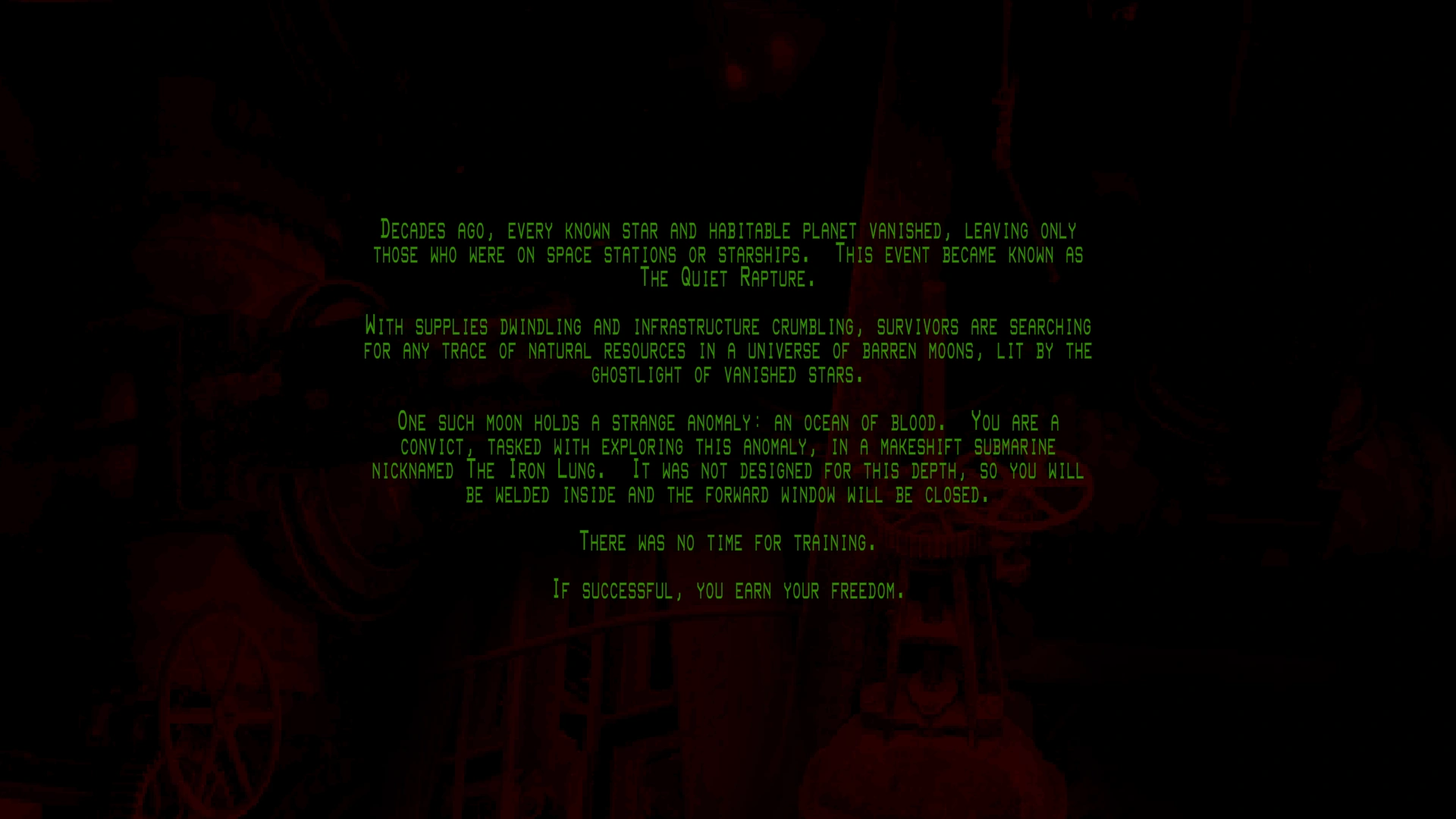
"Decades ago, every known star and habitable planet vanished, leaving only those who were on space stations or starships. This even became known as The Quiet Rapture. With supplies dwindling and infrastructure crumbling, survivors are searching for any trace of natural resources in a universe of barren moons, lit by the ghost light of vanished stars.
"One such moon holds a strange anomaly: an ocean of blood. You are a convict, tasked with exploring this anomaly, in a makeshift submarine nicknamed the Iron Lung. It was not designed for this depth, so you will be welded inside and the forward window will be closed. There was no time for training. If successful, you earn your freedom (
web)".
Conclusion: A Very Decent Horror Flick, and a Potentially Important Milestone.
One of the perks of going more or less blind into a film is that it frees you from the curse of expectations. If just the right combination of ingredients are in place, then sometimes not knowing all of what you're about to get can be just the right frame of mind needed for certain films. In the case of
Iron Lung, these ideal elements came together in the form of a popular source material combined with just the barest traces of good word of mouth. It meant I knew just enough about the project to get my interest, and never too much so that I knew quite what to expect. This left me in just the right sort of open frame of mind. Both the intellectual property and I were pretty much blank slates to one another, and so I was able to give it the benefit of the doubt as the lights went down, and the play began. What I got for this relative lack expectations is a film that rewards newcomers with a surprisingly taught and claustrophobic bit of Cosmic Horror combined with a surprising yet enjoyable amount of Psychodrama character study, that manages to gel together nicely with the overall overall direction of the plot. What this results in is one of the best gifts a moviegoer can ask for, an entertainment with some thought put into it. In the end,
Iron Lung that manages to achieve that rare combination of style and substance.
It's one of those films that's able to both delight its audience, and in doing so, it also somehow is able to set their minds alight with all sorts of interesting questions. That's because Fischbach and Szymanski have constructed the kind of story that wants it audience to ask questions. They're not out to subvert anyone's expectations, or anything like that. Nor are they trying to swindle their viewers with a cheap puzzle box approach. Indeed, compared to shows like Lost, the story offered here is refreshingly straightforward, and unencumbered by have to worry about lore. Instead, its a film that's more interested in presenting us with unanswered mysteries that nonetheless invite multiple interpretations from the audience, while also remembering that it's there to give them a good time, and also knows that the best stories are those that come with a genuine amount of closure at the end. This is a goal that Fischbach is able to supply his viewers with by the time the rather heartfelt credits start to role, and it left this viewer, at least, with a sense of the warm fuzzies knowing just how much the director viewed the final product as a true collaborative effort between equals and relative unknowns. That's a whole other behind-the-scenes aspect that we'll have to get to. For the moment, there's the narrative to consider.
In terms of plot, what Szymanski and Markiplier have to give their viewers is a story that benefits from its simple and straightforward nature.
As YouTuber Zac Morris, of CZ's World, explains: "The original game...is a minimalist Horror experience set in a universe where every known star and planet has suddenly vanished, leaving behind only a handful of survivors. The player takes on the role of a Convict, navigating a Blood Ocean by following coordinates on a map". Markiplier has taken Szymanski's initial premise, and expanded upon it as
Ryan Hollinger observes: "The film immediately drops us into the shoes of Simon (Fischbach), a convict who is offered his freedom in exchange for navigating a poorly engineered, dilapidated submarine, fittingly nicknamed the Iron Lung, through" the "mysterious Blood Ocean that encompasses an entire alien moon. While Simon's initial goal is to discover some fleeting hope for humanity in terms of resources, it quickly becomes apparent that something profoundly monstrous lives deep within the Blood Ocean, that's omnipotence far exceeds human comprehension". What we're given, in effect, is the feature-length equivalent of a Bottle Episode. The kind of story that absurdist playwrights such as Samuel Beckett specialized in, where the entire narrative and its action remains confined throughout to a single, claustrophobic stage or set.
It's a storytelling choice that is particularly fitting for a game adaptation that sees the Player confined throughout every walkthrough to a single level consisting of a limited amount of cramped, broken and leaking submersible space to move around in, all while the sense of a mostly unseen menace starts to creep ever closer to you, biding its time, and waiting for the perfect opportunity to strike. In retrospect, it becomes easy to see why Szymanski's game took off so well as it did. He's basically taken the fundamental premise of all video games, and flipped it on its head. Where most platformers revolve around the Player moving a sprite, and having it traverse across any number of levels, the unexpected beauty of a game like
Iron Lung is that it makes the deliberate decision to take that specific form of agency away from you, thus making the Player aware of just how much their sense of personal safety relies on being able to move about the level to a point where they can guarantee their own self-assurance and survival. By placing you at the mercy of a natural liquid element in an unnatural set of circumstances, Szymanski is able to effectively play on two of our most potent fears like a well-tuned violin.
Iron Lung is a game that relies on our fears of entrapment, blended with the fear of being stalked and hunted by a threat that, for the most part, we cannot see. Markiplier takes all of these elements, and is able to find just the right number of ways of making them work in a cinematic format.
In fact, when I used the term Bottle Episode to describe the film, there's another sense in which that works as a pretty apt description. As the film went along, I kept thinking of how well this could have worked as a episode of one of those classic Sci-Fi-Horror anthologies like The Twilight Zone or The Outer Limits. It's all too easy, for me at least, to imagine an alternate Black and White version of this film with someone like William Shatner, George Takei, or any number of other once well known character actors from Hollywood's Silver Age, such as Robert Culp, Cliff Robertson, Rod Taylor, or Dick Miller or Dean Stockwell in the role of the Convict. In terms of the kind of mood and atmosphere that Fischbach is able sustain, perhaps the pleasant thing about it was the realization of how well it could fit in the with the kind of weirdness ambience that earlier filmmakers such as Rod Serling, and Horror authors like Robert Bloch, were able to maintain in their own works. What makes all this work, however, is that in the end, both Markiplier and Szymanski are smart enough to know that all the best atmospherics can only work so far as they function in the service of any kind of halfway decent story. It's when we come to an examination of the story being told that things get a bit trippy or out-there.
Just to give everyone a bit of a heads-up, from here on in, my analysis of the film will not be in a vacuum. Instead, I'm going to rely on the commentary provided by Zac Morris, for the most part. In addition, there will also be input from the aforementioned Ryan Hollinger when it seems necessary, as together, these two seem to be the ones to best summarize the ideas that Szymanski and Markiplier seem to be steering a course around. In particular I'll be relying on the insights of Morris most of all, as he is the one who provided the greatest level of information as to the mind of David Szymanski, and the kind of the thought process that went into
Iron Lung, not just as a game, but also as a film adaptation. What Morris's commentary reveals is a creator with a definite point of view, and Markiplier seems to have allowed that vantage point to seep into the DNA of the movie. The is best demonstrated by the fact that Fischbach sees fit to give Szymanski top billing over the rest of the cast and crew (including himself as ostensible director) as the reigning Ideas Man whose thinking is what powers the overall direction (or engine, if you will) of the film. It's got to be one of the few times I'm aware of where the writer and script are valued more than the director of the film.
With all this in mind, my big takeaway from this picture is dependent on the film's plot, and how Szymanski's own outlook might be said to influence the story Markiplier has to tell. To start off at the basic level, the narrative of Iron Lung is perhaps summed up best in the words of Ryan Hollinger. The film details "how a coalition known as the Consolidation of Iron is attempting to untie the surviving colonies under the same ideal" of survival in the wake of the Quiet Rapture, "to safeguard mankind's future. However, one of the largest space stations, entitled Eden, rejects this unification in favor of independence, as they basically act as a cult who worship the last surviving trees that represent a glimmer of natural purity in a universe now wrapped in total darkness, and soulless man-made, mechanical infrastructure...This information is loosely fragmented across the film. As it comes to light that Simon was born into Eden, and was later instrumental an attack at one of the C.O.I's territories known as Filament Station. That resulted in the death of several dozen innocent people...Simon claims that this was an accident, and is deeply distraught over the meaningless loss of life he "indirectly" caused. Hell, while the extent of his involvement is left to speculation, his execution is initially framed as an "eye-for-an-eye, a-tooth-for-a-tooth" type punishment, until there's a legitimate to chance to transform his redundant, guinea pig status into a potential meaningful sacrifice".
As the plot progresses, and the prisoner's situation begins to seem more dire, Simon "all but admits to being raised in complete disillusionment...until he's able to find some tangible evidence of hope, in the form of a data archive lost by the previous expedition". It's from this point on that the film slowly begins to turn over the rest of the cards guiding it's plot, and the final result leaves us thrown for a loop, as we're left to question the exact nature of all that we've seen and heard up to this point. While Szymanski, and hence Markiplier, are content not to spoon-feed answers to their audience, there may be enough clues left lying around for us to piece together a rough idea of what's going on here, and what is happening to Simon as his journey into the depths progresses. Without going too much into spoilers, what I came away with is the idea that I was watching a story where both the
Inferno and
Purgatory of Dante Alighieri, as well as perhaps some extra ingredients from John Milton's
Paradise Lost were tossed into the mix, and all of it was combined with the more out-there, and mind bending themes and tropes most commonly associated with the aforementioned
Twilight Zone episode vibe that the film overall tends to give off. While this can never be a definitive take, one possible reading of the film is that the main characters aren't the victims of some cosmic anomaly. Instead, their current status ties into a line delivered in an audio log by a previous convict. That they are all, in essence, "Beyond the Veil".
In other words, one reading that might help make sense of the film is the view it as an essentially
Sixth Sense type situation, where the entire narrative is reframed if we look at it as a drama about learning to make up for, and let go of past mistakes, and then find a possible way of moving on to better things. If you need it spelled out in basic terms, what if all the characters are dead, and the blank and empty space they find themselves in is a place of judgement that could turn into either hell or a kind of purgatorial way station before passing on further to a potentially brighter future, for lack of a better word? Now, to be fair, I have some idea of how weird that all must sound, yet this is one possible scenario for the film that Fischbach and Szymanski leave us with. An extra added bonus of this take is that it does at least tie into somewhat to the thinking that Szymanski claims he tends to put into his own games and stories as a whole, and so it can at least claim to be taking the artist's point of view into consideration. In addition, Hollinger makes a note that Markiplier was a big fan of the movie
Dead Space, and that this is one similar source material that the director admits as a conscious influence on
Iron Lung. Going with the "Dead All Along/Afterlife" interpretation does also help make sense of several moments, and lines of dialogue in the film as well. For instance, there's a point in the film where Simon finds himself lost and stranded somewhere off the map. After piloting the sub aimlessly, he makes contact with someone who identifies herself as the lead researcher of SM-8, a previous expedition team (Elise Lovelock), Elli.
It's in their initially normal yet increasingly strange exchanges of dialogue that the film begins to show how it can be at least somewhat indebted to the writings of authors like Milton. For instance, when the voice of Elli first makes contact with the prisoner, she does so in an effort to guide him toward an encounter with some cosmic entity referred to only as The Light. At first, Elli's tone towards this Light approaches that of reverence, even going so far as to outright call it "our salvation"! What follows, however, is interesting. Simon has what can only be described as a very trippy encounter with the source of this Light, and when the vision is over, Elli's entire tone has shifted to one of hatred, verging even on a kind of undefined yet genuine type of jealousy. From this point on, the tone of reverence is out the window, and Elli now insists that no one must ever find about this strange source of Light. In fact, one interesting piece of her dialogue comes from when she frantically asks Simon a question: "Why you...What did it see in you"?!! What makes this brief outburst from the character intriguing is the ways it seems to function as a layered statement of dramatic dialogue. On one level, it seems an honest question. On a second level, there's this sense of angry accusation, implying that some form of favoritism is at play in a hidden yet implied agreement between Simon and the Light. On a final level, there's the odd yet persistent note of guilt attached to Elli's words in what she says to Simon. It leaves the implication that there are some things she won't tell us, and yet that she feels some regret over.

If it's at all possible to assign some form of guilt for an undisclosed action that makes Elli feels this way, then there's a strange ambiguity in the way she relates to it. At one point, just as she's about to go in for a kill, Elli has a moment to ask why she is the way she is, and what makes her act like a complete and total monster. However, any sense of pity that the character might've been allowed is soon dashed to literal pieces when Elli first decides to go ahead and take a life, and then compounds her actions by blaming Simon for making her do it, rather than admitting that something's very wrong and dangerously off with her mental state. It's in moments like this where the Miltonic echoes, for lack of a better word, begin to stand out the most. At least, this is the direction where my own English Major training began to head toward. The film's ultimate depiction of Elli is one that, to my reading, at ay rate, recalls a great deal of the way Milton portrays "the other guy" in his most famous poem. Elli's this odd figure caught up in a weird, love/hate relationship with this Light Source, and the way she reacts to it implies some level of history that neither we nor Simon are ever told about. Instead, much like the hapless Convict, it's just something we're made privy to, and then have to navigate around. In Simon's case, this almost proves futile. What makes a difference is a catalyst brought on by the protagonist's personal choice.
What ends up happening is a series of a events where Simon is ultimately forced into a confrontation with the entity known as Elli that resides within the Blood Ocean, and it's the outcome of this contest which might very well determine what happens to the remaining shreds of humanity lingering just above the surface. The remainder of the film's setup could almost be described as the classic dragon slayer routine, except the creature at the heart of Markiplier's feature doesn't quite fit the description of a flying fire-breather. Instead, Zac Morris's description of the Blood Fish as a form of the Leviathan seems to be a more accurate description. We may be dealing with a potential knight vs. dragon scenario, except that it's re-shuffled to reflect a more man vs. the sea variation, and the dragon comes in the form of a seas-serpent that is reminiscent of Dante and Lovecraft, with a dash of John Carpenter's
The Thing, along with some added Miltonic notes to its character. In terms of how Simon's own personality, and even humanity as a whole, fits into such a setup, then here is where I think it helps to go back to the film's more
Twilight Zone style elements. Basically, Simon seems to fit in best with a particular type of characterization that Rod Serling often used to tell his stories on TV every week.
The Zone always seemed to rely on a handful of personalities at the heart of each story. Many of them harkened back to the kind of clear cut moralism as that found in the original Tales from the Crypt comic books, yet Serling also found room to expand upon this old Gothic formula. In essence, the Zone's main leads existed on a spectrum between Good and Evil, with the exact nature of their ultimate fates varying from one episode to the next based on how or whether or not they let their moral sense inform the decisions they make. Stories centering around villain protagonists, for example, were always the most straightforward. It's the classic folktale setup of cosmic justice being meted out to the wrong-doer in an appropriately gruesome, or at least fitting, ironic, and surreal a fashion. It's when we come to Serling's more complex and sympathetic characters that things get a bit more interesting and open-ended. Sometimes they are innocent victims caught up in terrifying circumstances they can't explain, while at other times, they are able to locate or achieve a fitting and fulfilling sense of justice whilst navigating their way through the complex surreality that is the Zone in and of itself. Simon seems to fit in best with Serling's morally ambiguous protagonists, and that's probably the best lens to view him in.

While he starts out as this seemingly normal guy who you might feel bad for, and hope to see make it out alive, the clever twist with Markiplier and Szymanski's story is that a great deal of how the plot unfolds is determined to a surprising degree by the nature of Simon's character, and the extent to which he should be considered as having a reasonable amount of guilt to his past and actions. Aside from his immediate situation, the other major crux of Simon's narrative arc is his past as a member of Eden Station, and how his upbringing in what is essentially a religious cult has marked his personality and the choices he has made as a result of that. In the film, he's a man whose reputation precedes him, with various characters referring to him by the nickname of "The Butcher". What becomes clear on repeat viewings is that the film is asking you the viewer to act as judge and jury over whether or not Simon deserves his title of infamy. The film lays out that he took part in a violent siege against Filament Station; a conflict so brutal that it left the outpost damaged beyond repair. Throughout the course of the runtime, Simon tries to make clear time and again that he never meant for things to get as carried away as they did, and that he even tried to stop the bombing that took Filament Station out of commission, along with at least 60 lives along with it. The Convict keeps up this protestation of innocence throughout the film's runtime, and yet there comes a point where the truth may be a lot less clear.
.jpg)
It starts in the conversations Simon has with Elli, where the disembodied voice of the Leviathan begins to toy with Simon's sanity by playing on his sense of guilt for the death of Filament Station, and its inhabitants. What's interesting about these exchanges is that it's as if the beast is able to read the Convict's mind, and knows just what part of his psyche to go for, in order to torment him for the responsibility he bears for his actions. Again, this ties into the Dante-esque elements of both the plot, and of how it handles its two main characters. In fact, the conversations Simon has with the Leviathan seems to have had the effect (desired or otherwise) of unlocking a lot of his own past that the Convict has been trying to hide away, even from himself. This seems to become most clear during a point in the film's third act. To set the proper stage for this moment, Hollinger sums it up as follows. "When Simon discovers the data archive, in the second half, the story begins to notably reinvigorate itself, and give the characters new-found reason to fight for hope, amidst the constant conflict and chaos humanity habitually spirals into during desperate times, reflected in the senseless destruction of Filament Station". All of this is true, yet what's interesting is what happens on the road to this exact point.
There comes a moment after the reinvigoration Hollinger talks about has taken place. Simon has found some new motivation, and has kicked things into high gear by piloting the sub to what he hopes will bit his ticket out of his liquified version of hell. As he's making his way towards his rendezvous point, however, he begins to hear voices echoing in his head. Some of them are clearly memories from his past, while at other times, it's almost as if he's having conversations with ghosts that he can hear, yet can't see. It's the information contained in these hinted at snippets of backstory that make me realize that we as the audience are meant to sit in a place of judgement on this character, and perhaps should have assumed such a vantage point from the start. The memories Simon keeps flashing back to at that moment provide details of a man with a violent temper. We hear the voice of someone who was raised in fanatical religious background, and how he's allowed this to shape him into a dangerous renegade soldier whose violent nature has allowed him to earn the title of Butcher. There is even a clever moment where we hear an angry preacher's voice reciting the mantra of Eden Station, and it's difficult to tell if the voice belongs to someone else, or if we are hearing Simon himself delivering a fire and brimstone speech to an assembly of fellow fanatics that he still refers to as his "Brothers" in the film.

We then hear sounds of Simon living up to his reputation as a merciless soldier in combat, right up until, for whatever reason, we hear him speak in a different tone once things at Filament Station begin to go south fast. There's even the possible hint that one of the Brothers he is speaking to in his memory is also one of the previous convicts sent down to the Blood Ocean in an earlier expedition, and that this same fellow traveler is not only the one who left behind a note that helps Simon gain more control of the Iron Lung, it's then somehow implied that the man's unseen ghost has somehow established contact with the protagonist, and there's a moment when Simon chews him out, and the disembodied spirit says, "I'm just the Guy Who Told You to Cross the Wires". It's all part of the film's trippy aesthetic, yet it also seems to serve as a clue to the audience that perhaps we're meant to take a much more critical view of the main character than our initial impressions of him lead us to believe. It implies that maybe Simon really is the ruthless Butcher that everyone claims him to be. If we go by this reading, it does reshape the nature of the story we're watching to a considerable enough degree that it allows us to intuit a perhaps greater sense of purpose and coherence to the events that befall the story's main character.
.jpg)
As Zac Morris observes, it posits a reading where Simon's being sentenced into the Blood Ocean functions as a metaphor for the punishment of a guilty and violent man, with the blood symbolizing the lives that Simon took during his time as a committed fanatic. Meanwhile, the sense that the journey he undergoes has or contains echoes of Dante and Milton makes sense if we see his time in the Iron Lung as a kind of trial where the Convict is held under examination and judged for his crimes in a fundamentally hellish setting. The purgatorial aspects, meanwhile, all stem from the nature of the ending, where it's implied that Simon is able to find at least some measurable level of redemption for himself, with the possible hope held out for humanity as well. In fact, it is possible to take Morris's symbolic reading of the film's Existential themes, and expand on them as a form of explanation for the overall events of the movie. You could, for instance, posit a theory about the plot and its meaning in the form of a question.
What if the Sun, the Earth, and all the other stars haven't really gone anywhere at all? What if there was no quiet rapture, merely a series of unnecessary deaths, followed by a slow yet collective moment of judgement. In other words, what if all the characters are dead souls? What if its's true that a conflict did break out between Eden and Filament Station over a pointless bunch of ideological differences, and the resultant battle caused the deaths of all the characters we see? It wiped them all out, and left the actual Universe intact, and mourning lives lost in a minor and petty squabble? One that took place as the result of two clashing space stations in competition with one another? It was an ideological argument between two not very bright minds, and one day things just got out of hand.

It would mean that what the characters view as an unexplained cosmic phenomenon is merely the result of what happens when they die by throwing their lives away in a deadly conflict that serves no real purpose except to satisfy the petty egos of the combatants involved. It would offer, for instance, an interesting explanation for how a character named Ava (Caroline Kaplan) went blind in one of her eyes, and even account for the facial scars that she wears every time we see her. The key point being that she didn't just lose half of her vision, she also lost the Earth-bound status of her existence as a soldier who died in the battle between Filament and Eden. In other words, one further way to read this story is that all the characters we see are dead, and the setting is meant to be a liminal space of judgement, for lack of a better word. It's an Existential setting that can be either hell or Purgatory for the members of Filament or Eden caught within it. A place where the choices you make while there determine whether you sink away for good, or else are offered the chance to move on to something better. Well, at least there's one reading of the film, anyway. If nothing else, it at least offers a reading that's in keeping with David Szymanski's overall thought process. Beyond all this there's the question of how the film works as a simple entertainment?

For my own part, I'm prepared to say I had great fun with this one. It might just be a latter day example of a rare occurrence in an age devoted less to original ideas or projects, and more to tent poles and franchises. What we've got on our hands might just be the big sleeper hit of 2026. It's a film that was one-hundred percent made out of the director's own pocket. None of the major Hollywood studios had a hand in its production, and it meant there really was zero interference from executive meddling, or anything like that. Everything you see up on the screen is nothing less than an honest snapshot of the artist's full vision. It's one of those cases where the making of this picture is just as interesting the final product. I'll have something to say about it at the close. Before we get there, though, there is at least one criticism of the film that I have to get out of the way. One of the major complaints I've heard people make is has to do with the film's length. The politest version of this gripe is when some viewers wonder if
maybe Markiplier could have trimmed things down a bit here and there? In other words, some folks think the whole thing runs on a bit too long. For better or worse, I'm not one of them.
At no point during my initial viewing did I ever feel bored, or that the pace was slacking, Instead, Fischbach seems to have found a way to use the still moments to help generate one of the best types of suspense. These are the moments when it seems as if things are starting to calm down, yet we as viewers know the threat is still out there, and we can tell its lurking about somewhere in the wings waiting to strike. This serves to create a proper edge-of-the-seat effect, where the viewer is always leaning in to the screen, and then involuntarily finds themselves trying to examine every inch of the frame under the unspoken yet implicit understanding that something is going to come out of the dark corners where the light can't reach, and then lunge out and grab you by the jugular. It's an expert example of how good storytelling can play on our survival instincts by letting our fears not just of the dark, but also of what might be lurking in it, send us into a kind of watchful surveillance mode. Far from this being boring or a poor creative choice, I'd argue that Fischbach instead is one of those filmmakers who knows that sometimes the best tool in the Horror writer's arsenal is the proper atmosphere of a silence tinged with menace, where the slow burn approach is part of the fun.
It's in these slow yet suspenseful moments of quiet that the skilled Gothic artist is able to step back and allow the viewer's own Imagination to help fill the dark with nightmares of their own choosing. For the record, this seems to be a deliberate creative choice on the director's part. In an online video, Markiplier flat out states that a definite part of his goals for the film adaptation was that he didn't "really care about doing broad appeal. I do what appeals to me. And with this, when I played the game,
Iron Lung had so many restrictions. You're in a submarine, you can't see, you have the worst camera in the world, and you can only
hear what's going on outside. Maybe some people would prefer a more "in-your-face" Horror experience, but this was very much, just like,
you don't know. And
that's part of the fun. It's not knowing". The fact that this doesn't seem to work for everybody seems to mean less that Markiplier is a poor storyteller, and more an indicator of how some in the audience maybe just don't have that much of an Imagination. It perhaps says something bad about audience expectations when a lot of the faces in the aisles have become a bit too accustomed to the kind of Grindhouse/Torture Porn approach to telling Horror stories. It means that there's been a forgetting of the subtler scare tactics.
It places the efforts of writers of genuine talent, like Shirley Jackson, at a distinct disadvantage. Artists like Jackson tend to favor and display their the Terror at the heart of their stories in a more quiet and understated manner, and in her case its some of the best stuff that anyone has ever done in the field. It's a technique that Markiplier relies on for a good chunk, if not for the whole entirety of his film. I think the fact that so many can't get on board with this kind of more subtle approach to scary stories says a great deal about how the Horror genre is perceived by pop culture at large, and that this puts the format and its practitioners at something of a long disadvantage. My own fear is that this means a sizeable chunk of the audience has grown accustomed to thinking that all the genre amounts to is just the sort of Freddy and Jason hack-and-slash gorefest, and that any other efforts that try to prove that's not the whole case, that there are other and different ways of making Things Go Bump in the Night will tend to fall on deaf ears, because many have grown too used to having buckets of blood thrown in their faces.
It means that when a potentially up and coming new artist such as Markiplier takes a different tack, or when a genuine older talent like Jackson tries to show that you can scare readers with just a few well chosen shadows, the results all sort of have no choice except to fall on deaf ears due to a lack of Imagination, and hence the lack of a proper understanding of what the artists are going for. If this is in any way the case, then it means the Horror genre has its work cut out for it. It may be that the next task going forward is to try and wean audiences away from the whole Freddy and Jason approach, and back towards a more moderated form of sending chills up the spine. There's no need to dispense with the buckets of stage blood, that will always have its place. It just needs to be used with more care, and maybe even a bit of necessary corrective restraint. The audience needs to reach a point where it can begin to understand what makes novels such as
Dracula or
The Haunting of Hill House succeed so well with little to no drops of blood. There's a whole shared space of artistry between Jackson and Bram Stoker that we seem to have lost sight of. Horror artists might now have to see if it's at all possible to re-acquaint and accustom their audiences back to this more sophisticated version telling scary tales.
It seems an unavoidable challenge to be met if the genre is to be prevented from stagnating into the worst forms of un-frightening self-parody. The good news is that's the only major
valid complaint I've heard of when it comes to this film. There's one other hurdle that Markiplier has had to put up with in bringing his dreams to the screen, and that has been the unfair and flat-out baffling reaction that studio Hollywood and the mainstream press have had to
Iron Lung. They've treated him and film for all the world the resurgence of Bubonic Plague. There are reviews out there that are reluctant to even go near him. They don't even want to know who this guy is, or that this film is a thing that's real. It all kind of forces me to agree with comments I've heard elsewhere. It does seem as if the older system of filmmaking is concerned with a sense of threat that a picture like this represents. There might just be a genuine fear that if a pair of complete independents like Fischbach and Szymanski can upstage the movie industry at its own game, then that might cause the worst sort of problems for Tinseltown somewhere down the line. There's even a rumor going around that IMDB removed Markiplier's film from its top rated list because of some possible studio pressure trying to eliminate the competition.
Now, for the record, I can't swear that any of that is the truth. It's just a rumor I've heard going around when it came time to study up on this film. All I can do is to point out how that would have to be some of the most petty bullshit I've ever heard of in my life if that ever turned out to be the truth. I mean like can you imagine if anyone tried to pull that same sort of crap back in the day when Lucas first released Star Wars, or when Spielberg debuted E.T.? That would be pretty embarrassing proof that the film industry prefers a stacked deck, and isn't as welcoming of honest artistic talent as it might seem. Then again, this is just only a rumor. The only other thing I have to address on the weirdness surrounding the reception of Markiplier's film is to leave off with a suggestion for Hollywood. If you're worried about the Indie Scene stealing your fire, all you have to do is one simple thing. How about you focus on doing nothing more than just telling a good story every now and then? It's sort of the main reason audience have been going to the movies for years. With that said, if it should turn out that Tinseltown really is experiencing a drought due to a shrinking talent pool, then if the industry isn't careful, Hollywood might sooner or later have to compete with some real competition from Indie cinema.
That's sort of the final takeaway I've been left with on this review.
Iron Lung seems to be one of those sudden flashes of quiet Inspiration that manage to catch audiences and professionals off-guard. We're dealing with a film of such quality here that in an earlier age, Fischbach and Szymanski would have had agents and studios knocking on their door ready and willing to turn them into the next generation of filmmakers. I think it's a testament to how much the business has changed to the point where someone who does manage to put his own personal vision up on the screen is now treated with a sense of unease, and is all but shut out of the conversation of where film is headed these days. Something tells me that if Lucas and Spielberg had released their magnum opuses today, they might very well meet with same fate as Markiplier. If that's the case, then perhaps it means that the old movie studios really can't nurture talent the way it used to anymore. That's sort of a shame, because a film like
Iron Lung is a picture that deserves a lot of love and attention from audiences. What we've got here is a fine Indie hit that is helmed by artists who know and remember all about what makes for a good Horror flick. It's a cutting edge breakout project that also harkens back to the classic Creature Features of a bygone age, while also injecting a lot of today's modern sensibilities into the mix in a way that doesn't create a tonal clash. Instead, Mark Fischbach and David Szymanski have crafted a film which they can be proud of.




.jpg)
.jpg)


.jpg)

No comments:
Post a Comment