Saturday, January 10, 2026

Pullman Car Hiawatha (1931).

I've talked about him once before, yet more as a jumping off point, rather than as an artist in his own right.  Not too far back, last year, I did an article on a book called The Bridge of San Luis Rey.  I might have done at least some kind of decent enough job in covering the story and themes of that novel.  However, if you go back and take a look at that article it becomes pretty clear real soon that all I did was use that novel as a means to an end.  I used the The Bridge of San Luis more as a jumping off point to discuss one of the overarching themes in Stephen King's Dark Tower series.  I blame the creator of the fictional realm known as Castle Rock, Maine, for that choice of focus entirely.  As I also made clear in my Bridge review, it was King himself who set me on a trek through that book by his choosing to highlight that it was a keystone text when it came to the author's obsession with questions of Fate and Free Will, or Ka as he chooses to label it in the pages of his Mid-World saga.  As a result, while I was able to give the this now obscure work of Modernist literature its due day in the spotlight, it's also a fact that my main focus in explicating its meaning was by and large in relation to King's fiction.  I never even bothered to spend much time focusing on the author of The Bridge.  Neither in terms of who he was, or whether he was the kind of talent that deserves to be remembered for anything, except as part of King's writer's toolbox.  I'd like to see if I can remedy that, at least somewhat, with this review today.  

The key challenge here will lie in seeing just how far Thornton Wilder stands on his own, as much as how he relates to King's work.  The best place to start is with a formal introduction to the life of the artist, and for that I've been lucky enough to stumble upon a very helpful summary provided by Mildred Kuner.  In the very first chapter of her study, Thornton Wilder: The Bright and the Dark, she has given as good a summarization of the facts of the writer's life as I am able to find or offer anywhere.  So with that in mind, I'll let her make First Introductions.  In describing her subject, Kuner, writes: "Regardless of what he writes, he generally celebrates the music of the spheres and, simultaneously, what he regards as its inevitable counterpoint - the rattle of the dishes.  Thornton Niven Wilder was born in Madison, Wisconsin, on April 17, 1897.  His father, Amos P. Wilder, son of a clergyman and a devout member of the Congregational Church, was a Yale graduate who had become a newspaperman and who eventually entered the diplomatic service during the administration of Theodore Roosevelt.  His mother, Isabella Thornton Niven, was a woman equally dedicated to...intellectual pursuits.  

His elder brother by two years, Amos Niven Wilder, became a professor of theology and the author of several books dealing with the influence of religion on contemporary poetry; a sister, Janet, became a zoologist; another sister, Isabel, became an author (she has written three novels and also has coauthored several articles in collaboration with her brother Thornton) and in later years has generally served as th buffer between him and the world whenever his engaged in one of his literary projects. Significantly, he dedicated his sixth novel, The Eighth Day, to her, for when he retired to the Arizona desert for twenty months, determined to communicate with no one until he finished his work, it was she who looked after his interests in his absence.  In her he has found a spiritual twin to compensate for the loss of his actual twin who died at birth.

"In 1906 Amos P. Wilder took his family to Hong Kong, where he served as an American consul general until 1909.  For a short period young Thornton attended school there - a strict, German-language school - so that at the age that at the age of nine he had already been exposed to both the world of the Orient and the culture of Europe, equally alien to all he had previously known.  (One wonders how much this early experience contributed to his later artistic interest in exotic settings.)  After six months his father sent the family back to the United States, not to Wisconsin, but to Berkeley, California, where Thornton attended the public school.  By 1911, when Amos Wilder was serving in Shanghai, the family had returned to China, where Thornton was enrolled first in another German-language school, then at the English Mission School in Chefoo, until 1913.  At that time the family came back permanently to California, where Thornton attended the Thacher School in Ojai, graduating from the high school in Berkeley in 1915.  At the age of eighteen he had seen more of the world than many people do at forty-eight and he had learned early that a home is based not on a physical location but on human relationships.  Not surprisingly, his books have no strong sense of property or of material things; everything he writes is permeated by a vivid feeling for family ties (1-3)"  Kuner sort of walks right past the real crux of Wilder's fiction here, while at the same time catching a fleeting glimpse at its.

There'll be plenty more to say about how the author treats the subject of families when it comes to a proper discussion of the play at the center of this review.  For the time being, it will be enough to note that trying to separate the themes of Wilder's fiction from that of Steve King is going to be perhaps harder than I expected.  That's because there is one shared element between both artists that unites them on a certain fundamental level, and it impacts the ways in which each writer tackles the subject of familial and social ties.  For the moment, lets continue on with getting to know a bit more about one of King's lesser known Inspirations.

"When it came time to enroll in college, Thornton chose his father's university, Yale, but Amos Wilder, finding his alma mater too worldly for his son, insisted on Oberlin, a small Ohio college known for its splendid music department and its religious character.  At Oberlin young Wilder began writing seriously; in his two years there he contributed several pieces to the literary magazine.  In addition, he was fortunate enough to study with Charles Wager, a teacher with a passion for literature who kindled the imagination of his students.  Wager's interests, which, unlike those of some academic minds, were not narrowly confined to a minute area of specialization, struck a responsive chord in Wilder, for Wager's learning ranged over many countries and epochs.  It was probably from him that Wilder developed his own intuitive appreciation for writings of the past, for tradition, for history, for legend.  And Wilder's natural inclination in this direction was supported by precedent: both Shakespeare, who represented the end of an era, and George Bernard Shaw, who represented the beginning of one, deliberately selected for their material subject and characters that had already been exposed by artists before them.  Perhaps what most impressed Wilder was the discover that genuine masterpieces are timeless: in the words of ager, "Every great work was written this morning," or, in the modern parlance, is relevant.

"At Oberlin, too, Wilder first came into contact with that school of criticism known as...humanism.  A number of American critics...had grown contemptuous of that parochial kind of naturalism characteristic of American literature.  Such writers, for example, as Theodore Dreiser, who appeared to scrutinize only the petty, sordid, materialistic details of everyday life, seemed to the humanists to be abandoning all that was best and intelligent in man, to be concentrating on the gutter instead of the stars.  They felt that...the great classics provided the answer to literature and to life; books that stressed despair and deprivation could contribute nothing of lasting value.  This was a view that the young Wilder found very easy to accept (3-5)", yet I think it's best to pause here and add a qualification born of hindsight right here.  Everything I've learned about this guys leads me to believe that he qualifies as something of an American Renaissance Man.  The fiction of Wilder displays a very careful understanding of the Classics that Kuner talks about.  At the same time, a closer examination of the writer's output reveals a gap in her knowledge about his themes and meanings.  For one thing, Wilder seemed to know that even the gutter has its place, and that sometimes it can even send up flares or messages that people like the academe of places like Oberlin would do wrong to take for granted.  That's a mistake that Wilder never seems to have made.  In fact, there are elements in the play to be reviewed in a moment that tell otherwise.

Rather than revealing himself to be the Ivory Tower snob that Kuner seems to mistake him for, Wilder once more proves how he could have served as the Inspiration for a working class author like King.  The way he does this can be demonstrated if you go and take a look at an old 1943 film called Shadow of a Doubt.  Wilder wrote the screenplay for that film, and it was directed by some guy called Alfred Hitchcock.  The best way to describe that movie is this.  To look at it, to place the whole picture under a microscope is to get a fair enough idea of where a lot of the themes and plot points in the cinema of David Lynch originally stemmed from.  It's also the kind of film that might have left an impact on a young Steve King.  Shadow of a Doubt is a film that shares a great deal of thematic overlap in common with a movie like Blue Velvet, or a novel such as Salem's Lot.  Each vehicle takes a somewhat jaundiced view of small town Americana.  It's an idea that Wilder shares in common with the creators of Twin Peaks and Castle Rock.  There's the same sense of easy familiarity with the frailties, hypocrisy, cruelty, and sometimes even flat-out danger associated with living in a small town.  In the case of the Hitchcock film, Wilder treats his audience to the story of what happens when a serial killer played by Joseph Cotton returns to his idyllic seeming small town in an attempt to hide from the police on his trail.

Even the basic nature of that plot summary, stripped down to its essence, is enough to telegraph to veteran Horror fans the kind of tale we've got on our hands.  What it boils down to is that an outside evil descends upon the inhabitants of Anytown, USA, and in doing so proceeds to draw back the curtain on the dark side of American life.  It's something that artists like King and Lynch have in common with Wilder, and it's a trait he shares in turn with artists like Shirley Jackson, Flannery O'Connor, and above all, Mark Twain.  I'll have to admit that last name signals an aspect of Wilder's fiction that I don't recall anyone ever bothering to take notice of.  It's a bit concerning, because something tells me that if we could single out just what (if any) influence the author of Huck Finn had on the creator of Our Town, then we could go a long way toward figuring out what made Wilder tick.  All of which is to say that this artist's exposure to the ethos of Liberal Humanism seems to have had a way different effect than the one Kuner believed it to be.  Rather than making him into some disconnected, ivied academic, the writer turned out to share a certain kinship with the likes of Tom Sawyer.  Like Mark Twain, he "knew the average all around".  Unlike Sam Clemens, Wilder remained a lot more open-ended about human nature.  Twain once held that "The average man is a coward".  Wilder knew that cowardice is something any of us are capable of.  He was also willing to place his bets on this not being the whole story, either.

Instead, just like the Renaissance Humanists who Kuner identifies as his main Inspiration, Wilder tended to see people as any number of possibilities (some good, others bad) waiting to be realized.  His idea of the "average all around" encompassed the notion that people make or break themselves upon the wheel of life.  You can scale all the way up to the very roof peak of the stars themselves, and you can just as easily fall to a level beneath the beasts that perish.  That was always a question of mere human choice.  The one thing that Wilder seemed to have the most impatience with were those human failures that tried to blame fate for their own self-imposed predicaments.  Like I said, it's proving to be more difficult to separate the nature of Wilder's fiction from that of King.  From here, Kuner continues:

"In 1917 Wilder transferred to Yale, a move that was not entirely to his father's satisfaction; about the same time, the latter resigned from the consular service and with his family took up permanent residence in New Haven.  At Yale Wilder interrupted his education for eight months in order to serve with the First Coast Artillery at Fort Adams, Rhode Island; though he did not see overseas duty during World War I, he at least participated in his country's involvement with it, as he was again to do later, in World War II.  Leaving the service as a corporal, he returned to Yale in 1919 and, the following year, earned his Bachelor of Arts degree (5)". In all, it's possible to list at least two major influential moments in the author's life.  The first stemmed from the way both Wilder and his siblings were treated as a family by their father; more of which anon, as we get into the review proper.  The second counts as the most unremarked upon aspect in the development of the artist's mind.  However I'm convinced that, like King and Twain, the second major shaping factor in Wilder's talent was his growing awareness of how a lot of what was awry in his own household found its reflection in the troubles plaguing the larger microcosm of his original New England society.  Both of these influences count as negative impacts.

It was the third one, however, which Kuner talks about next, which seems to have acted as an organizing principle, of sorts.  Something that helped the writer give shape and form to a lot of what he witnessed, and that maybe helped him to gain some kind of perspective on it all.  It seems to have chimed with the writer's introduction to the content and toolbox of Classical Humanism that he imbibed in college, and hence acted as something in the way of a kick off point for Wilder's artistry.  "In 1920 Wilder went to Europe on a fellowship and studied at the American Academy in Rome.  It was there, he tells us, that one of the most memorable experiences of his life came to him: as a member of an archaeological team he helped excavate an Etruscan street, buried centuries ago.  And suddenly his awareness of this lost civilization, which had existed even before the Romans, had collided with his own moment in time clarified and confirmed all his previous thought processes: there was no past, present, or future to be considered separately; no geographical limitations could be taken seriously when an ancient culture could be laid bare by a modern American shovel.  As he was later to explain it in The Eighth Day: "It is only in appearance that time is a river.  It is a vast landscape, and it is the eye of the beholder that moves (5-6)".  It's not much to go on, yet it might be enough to start out with, at first.

So to recap, here we've got this simple New England kid who grows up with something of an outsized Imagination, and he's lucky enough to be born into one of those households that tend to have a healthy enough dedication to artistic pursuits.  This positive influence is offset by the fact that Wilder seems to have experienced his own version of the stifling and corrosive Puritanical atmosphere that Stephen King discovered for himself growing up on the streets of Durham, Maine.  Mark Twain experienced his own version of the same social maladies coming of age in the American South.  All of these negative impacts are once more off-set by a number of other factors.  The first is that his stint as an exchange student in China left Wilder with an inescapable experience of the vastness of the world, and the differing cultures that we as humans have been able to construct for ourselves.  It was this exposure to other societies (the Asian-Pacific, in his case) that allowed Wilder the chance to avoid the kind of limited provincialism that Mark Twain struggled with all his life, even when he knew he was just a small fish in a large ocean.  This was a form of knowledge that was brought home to Wilder in a greater fashion as he made friends with those on the lowest wrung of Chinese society.  It was this exposure to ways of living that were outside the box of his time that was then added onto by his exposure to Classical Literature in college.  This broad-minded approach to things seems to have struck home when he dug up a piece of the past.

When you put all of that together, what you seem to get is the kind of literary career that has gone on to have one of the quietest, yet impactful legacies in the history of American Letters.  It resulted in the kind of work that would later find echoes in the writings of J.D. Salinger as much as it could the Fantasies of Ray Bradbury.  It's a combination of literary realism that wouldn't have been out of place in a play by someone like Arthur Miller or Reginald Rose.  There are also moments where you have to wonder just how much this guy might have influence Magical Realists like Jorge Luis Borges, as well as Gothic Pastoralists like King.  To give a sample offering of what showcases as the best introduction to this man's work, I thought it might be interesting to take a look at a one act play that Wilder composed during his journeyman years.  It might not seem like much now.  Yet something tells me this piece functioned as an important stepping stone in the history of the author's career.  With that in mind, this is an examination of a work known simply as, Pullman Car Hiawatha.

Sunday, December 28, 2025

Donald in Math-magic Land (1959).

If you grew up a child of the 80s, then odds are even Disney was a big part of it.  Whether as an occasional presence that your parents popped into the pre-digital era VCR for you just every now and then, or else as the primary shaper of your Imagination growing up, it's fair to say that the Mouse House had a decent hand in molding how we remember our childhoods in some form or another.  For me, it came from two places.  Part of its was from the video cassettes my folks bought for me.  The other was growing up with a version of the Disney Channel that was a like a version of Turner Classic Movies if it was geared for the Spielberg generation.  You'd have early prototypes of the kind of shows you'd expect to find in a place like that, such as program blocks geared toward airing the classic cartoons featuring Mickey and the gang.  You'd also have classic standbys such as Chip and Dale's Rescue Rangers or Darkwing Duck.  Then you'd turn right around and the next thing you know, your kids would get a chance to be introduced to Humphrey Bogart in The Maltese Falcon, or John Wayne in films like The Searchers, or Stagecoach.  Then things might shift over to an anthology program called Lunchbox, which showcased actual independent animation from around the world.  After that, you might be introduced to a little known bit of childhood trauma fuel, such as Flight of the Navigator, or Dot and the Kangaroo.  Coming up next, the scene would switch rails again, and you'd be treated to the sight of James Stewart playing Mr. Smith going to Washington.  I'm not kidding, here, by the way, they had actual schedules of this stuff lined up all day.

You can even check out some of the classic Golden Age movies the channel used to showcase back in the day, followed by a heck of a lot more where that came from.  What I'm getting at here is that growing up with the Mouse Kingdom back in the 80s was a hell of a different experience from what it is now.  It was a lot more fun, for one thing.  You got the sense that you were in the hands of entertainers who didn't just know what that word meant, you also got the impression they had some kind of understanding of how much more it could mean with a little effort and honest creativity.  Growing up with the Disney Channel in my youth was similar in many ways to coming of age with the help of guys like Jim Henson.  There was this implicit sense of understanding that you were having your Imagination expanded and encouraged by the TV folks that your parents allowed to babysit you.  One of the programs that contributed to this sense of growing mental horizons also has to count as a product of the original Mouse channel.  Yet it also had a physical media copy thrown into the bargain.  It wasn't just any routine home video release, either.  It was part of an actual line of promotional material that the Company was churning out at the time.  The short film I'm here to talk about today saw its first home video release as part of the Walt Disney Mini-Classics line of VHS's.  I supposed the best way to describe it is to call it all a specialty brand that saw it its heyday in the years 1988 to 1993 (web). 

It was a back catalogue, of sorts, most which were no longer than perhaps 30 to 45 minutes of runtime, yet they seemed like features films in their own right, to a child of 7, at least.  The content of each video consisted of one helping from a number of extended theatrical shorts that Walt and his team put into theaters back in World War II, in place of their usual feature-length animated masterpieces.  This doesn't seem to have been anything that Disney was ever planning on.  Instead, it was all down to a matter of economic necessity.  With the bombing of Pearl Harbor, the nature of the reality around everyone began to shift into a new gear, and the same process held true for the Magic Kingdom.  When America found itself catapulted headfirst into the then new conflict, it didn't take long for Hollywood to find itself a willing participant in the War effort against Hitler and what were then called the Axis nations, Italy and Japan.  This resulted in Tinseltown grinding out an entire future movie vault's worth of propaganda in the forms of film and short featurettes.  Walt's company was no exception to this rule.  It was very much as historian Bowdoin Van Riper explains in his edited collection of studies, Learning From Mickey, Donald, and Walt: Essays on Disney's Edutainment Films

"The outbreak of World War II broadened Disney’s involvement with reality-based films. The studio turned out a steady stream of instructional cartoon shorts for the military—light-hearted in approach, but serious in intent—that were designed to educate soldiers, defense workers, and civilians on subjects ranging from recycling and personal hygiene to riveting techniques and the proper use of anti-tank weapons.10 The studio’s second line of wartime shorts was propagandistic rather than instructional. Not all the propaganda shorts were realistic—Der Fuehrer’s Face plunged Donald Duck into a surreal, night marish vision of life under the Third Reich—but all sought to present reality as Walt Disney, and the country’s wartime leaders, saw it. Education for Death purported to show how Nazi Germany indoctrinated its citizens, beginning in early childhood. The most ambitious of these wartime propaganda films was the 1943 featurette Victory Through Air Power. Mixing various forms of animation with stock footage and lectures by Major Alexander de Seversky, it made the case for aerial bombing as a decisive factor in modern warfare. The demands of wartime diplomacy—specifically the need to foster good relations with Central and South America—gave rise to Saludos Amigos! (1943) and The Three Caballeros (1945). Mixing animation and live action as Victory did, they too were designed to make a broad point: that Latin America and the United States were natural allies, and their peoples similar in culture and outlook (5)".

The minor punchline involved here is that the main reason for all this innovation was the need to keep the Kingdom from financial ruin after Hitler and the Nazis pretty much busted the company's chance for overseas revenue from films like Snow White, Pinocchio, and Bambi.  These are all cited as some the studio's best work for any number of reasons.  The trick is none of that artistry seemed to have made much of a difference when you're dealing with a mind that's out to lunch.  So, the War ate into company profits, and Walt was left having to scramble for ways to keep himself and his life's work afloat.  One of the ways in which this was done was through the easy income of making wartime propaganda.  The second, and most important way to do that was to create a series of short films.  The trick is that if you were to create a number of these pictures (too long for a regular Mickey cartoon, but not long enough for a full-length feature) and paired them together, then however lopsided or dichotomous the final results, you'd still be able to keep the brand alive and remind people that the Disney name was still in the running and part of the overall landscape of Hollywood.  It's the kind of strategy that's counter-intuitive in whatever remains of today's industry, yet there must have been some logic in their favor.

Because by combining two or more short films into one package, and placing them in cinema's, Walt somehow found a way to make it all pay off.  As a result, this part of his career became known as the Package Era.  Perhaps a better way to look at it is to say that Disney was the man responsible for the creation of the anthology feature film.  Works like The Adventures of Ichabod and Mr. Toad, or Fun and Fancy Free were the result, and later on the short works that made up those anthologies found themselves further repackaged later on down the line as part of the studio's line of Mini-Classic re-releases.  The result was that kids like me got our first exposure to adaptations such as The Wind in the Willows, The Legend of Sleepy Hollow, or Mickey and the Beanstalk from this now obscure video series line.  Donald in Mathmagic Land was part of that same lineup for me.  The first time I ever saw it was as a copy of VCR era physical media.  It was the kind you could hold in your hands.  When you unpacked it, there was a switch in the upper lefthand side of the cassette that would allow you to open up the lid covering the entire top half.  Once you did that you could see the reels of film the entire picture had been printed on.  Somehow our not so distant ancestors managed to pack an entire story onto such primitive tech, complete with a full orchestra and glorious technicolor.  It's been a long time since I've stopped to consider some of the remarkable contents of this simple educational video that was designed with children's schools in mind.  I'd like to take the time to unpack some of those contents. 

Sunday, December 14, 2025

Jim Henson: Idea Man (2024).

This is the first day I can remember.  It's not my first memory, by any means.  Not by a long shot.  There are other times, places, and faces that I can recall happening before this moment.  The trick with all these other events is that they fall prey to the spotty, patchwork quilt quality of that brief yet crucial span of time when the human mind is still busy assembling itself into something like a fully fledged consciousness.  Before the day I'm talking about, all I have to go on are all just snippets, or bits of fragmented pieces of things I saw.  If I had to take a guess, then it might be that this is what the start of everyone's childhood is like.  The funny thing about it in my case is that what I recall with anything like crystal clarity isn't the house I grew up in, or things of that nature.  Instead, it's all scenes from various movies.  The first fragment seems to have been more or less the entirety of Return of the Jedi.  After that it's Christopher Lloyd doing his best Harold Lloyd impression on the hands of a giant clock tower, during the big finale scene of the original Back to the Future.  After that I might have made the acquaintance of an explorer and British expeditionary soldier by the name of Lawrence of Arabia.  Then, all of a sudden, I'm confronted by a musically inclined individual with funny looking hair, who goes by the even stranger, yet somehow fitting name of Amadeus.  Not long after is when I got to meet the first of what I've come to think of as the 80s Uncles.  It's a term I use for how I've come to regard all of the major blockbuster directors of that decade.

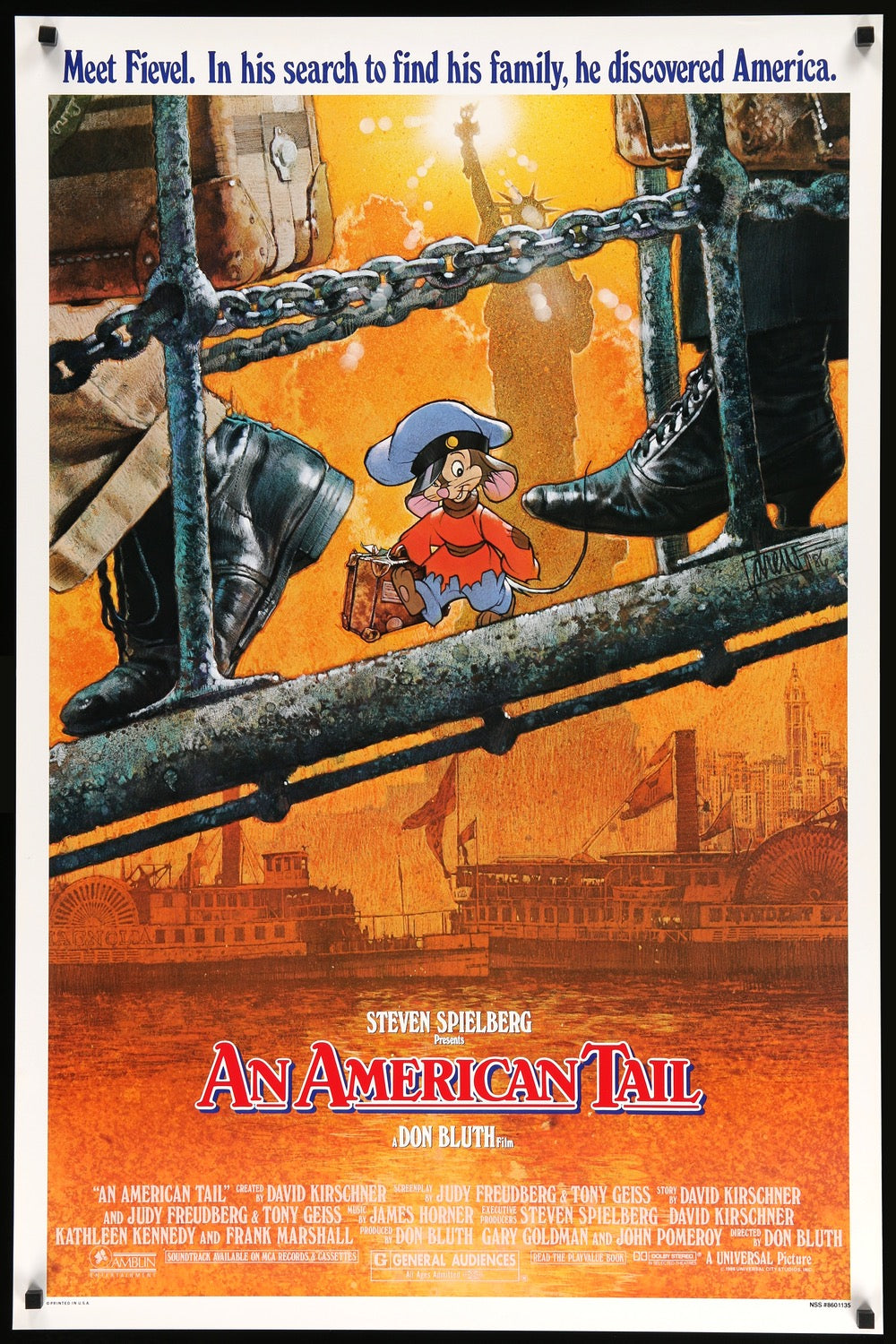
He's not the one I saw on that first full day in the life that I can recall, yet you can trust me when I say that Don Bluth's American Tail was one of those pictures that left a hell of an impact.  You think that film's impressive through through adult eyes?  Try watching the whole thing when you're barely more than five years old, sitting on the floor in front of your parents brand new (and long since discarded) bulky 80s Big Screen.  I've just learned how to form full sentences, and just like that I'm being introduced to my first and most abiding sense of the Gothic, the Enchanted Sublime, and an idea of the Epic Scope that has remained with me all my life.  All of this is an accurate enough description of what it felt like to watch that movie.  Yet trust me when I say that I still haven't scratched the surface of the kind of emotional impact a film like that can leave on just the right type of receptive mind at the best possible time.  Yeah, all the old cliches of 80s Trauma Fuel apply, yet that doesn't even scratch the surface either.  For me, it was like discovering what it meant to be alive.  Let's just say there's a whole trove of themes and ideas to a film like that which makes it all worth talking about.  It's something I'll have to make my way toward, somewhere down the line.  

My point for right now was that this was my first intro to the group of guys I call the 80s Uncles.  These were the filmmakers who more or less went on to construct what the very idea of childhood was like for us 80s brats.  In no particular order, I'd have to label them as Uncle George, Uncle Joe, Uncle Steve, and you've already met both Uncle Bob and Uncle Don.  For now, however, I want to talk about the day I met Uncle Jim.  It was the first complete day I can remember.  This is how it started.  I might still be just five years old.  What matters is that this marks the first moment where I become aware of my surroundings.  I'm dressed in my pajamas, and I'm making my way into the family living room from the dining area in my parents house.  The big blocky outline of our early big screen idiot box is there waiting for me, and it's turned on.  The first action I can ever remember doing is just sitting down once more in front of the screen and taking a look at what's there.  The next thing I know, I'm a being introduced to what looks almost like a barnyard menagerie that's come to animated life, and has somehow gained the ability to talk and wear the same kind of toddler's clothes that I was still in back then.  There's a green little frog on the TV, and he's sharing the spotlight with a pig in a pink dress.

Both of them appear to be at about the same age, though the girl might be just a smidge older than the tadpole she seems to want to dote on for some reason.  Tagging along with the pig and the frog is a talking bear in yellow pjs, and a beany hat, followed closely by a strange looking creature with a long nose and big, goggling eyes the size of tennis balls.  Close in tow is a piano playing dog, along with a brother and sister duo who are just as strange looking as the little blue weirdo (for that's what everyone calls him, and how he insists on being seen).  The funny thing looking back on it now is that none of this seemed out of place, the way it might to the eyes of a disenchanted adult.  Instead, the first thing that strikes me as interesting about my introduction to this setup is just how normal it all seemed.  Without missing a beat, some part of my still developing mind took this all in and accepted it without missing a beat.  It was as if we'd already known each other for years.  I guess you could chalk that up to just how much these cartoon kids made me feel welcome as a viewer, if that makes sense.  Whatever the case, what happened next was that I more or less followed these animated nursery inhabitants as they first browsed through a supermarket in a Plutonium power shopping cart, then ditched the idea to focus on growing muffins in a rural farming area that owed more to the world of Dr. Seuss than it did to anything related to the real work of soughing, ploughing, and harvesting.  That's how it all got started.

It was the first time I ever met Jim Henson's Muppets.  The fact that it was as a bunch of animated toddler forms of their usual adult selves really doesn't seem to have made all that much difference.  It was just the gang, you know.  No one except the characters themselves.  It's like you could take the way they were portrayed on Muppet Babies, then go back and look at how they were in their primetime debut with Th Muppet Show, and the strength of characterization given to these imaginary figures is so seamless that it has to count as an underremarked upon creative accomplishment in terms of the artistry that's gone into the writing of Henson's main cast.  In an age where there's the constant risk that showrunners have next to no clue as to how write with a sense of dramatic consistency to the characters in their charge, the level of cohesion that Jim and his friends were able to imbue the Muppets and their other creations with just comes off sounding like the unintentional yet genuine miracle it now is.  The thing is, none of this ever came up overnight.  The life of the Muppets is a story that will forever be entwined with that of their creator, and the trick with an artist like Jim Henson is he was a Man of Ideas in the truest Renaissance sense of the term.  At the same time, all of this creativity didn't just spring up ready made in a day.  Even if he was born with a nascent talent for tapping into the Imagination, the ability to both wield and then use this talent well was a long process of trial and error learning.

It's the kind of subject which by rights should be able to fill up several volumes of study.  A good source for what I'm talking about is the personal journal Jim kept to chronicle the flow of his own ideas.  Parts of this journal were published not long ago as Imagination Illustrated by Karen Folk.  While it's by no means the entirety of that journal, the content that was available to the public contains enough information that entire works of history and criticism could be made just from the chronology of moments leading up to the time of Henson's first public success as a puppeteer in Washington DC's local television sector.  Indeed, it even makes sense that a full-length book should be written about that time, as its one of the key periods in the artist's history where all of his talent was successfully channeled into a proper first showing.  That's something worth examining in full.  There's just so much worth learning about that time in Jim's first major step in his artistic development that I can even see some intrepid scholar with enough gifts not just penning a successful history of those early years, but of also having it turned into one of those recent string of biographical films that can either sink or swim on the skill the filmmaker has in knowing which parts of their subject's life deserves to have the camera
trained on it.  In some ways, I'm staring to wonder if maybe that's what Ron Howard should have done.

Sunday, November 30, 2025

Won't You Be My Neighbor (2018).

"I've been thinking of a series of dreams" - Bob Dylan.

Once upon a time, a young boy was taking his dog out for a walk, and something happenedThe details at this point are sketchyThere may be truth to the lad's words, and, of course, he could have made this part up.  The way he tells it, the boy was taking his pup for a simple afternoon stroll, out among the French countryside just outside of the village of Montignac, in the district of Dordogne.  At first everything seemed normal, until the lad heard his companion begin to bark.  He was well off into the countryside, now, and already it was possible to catch a view of the peaks and hill tops of the Vezere Valley which enveloped the region of his village.  When the boy heard his dog barking, his first instinct was to look for where he last saw him.  That's when he got his first real shock of the day, though there would be more.  To start with, however, the dog was nowhere in sight.  He could here the mutt's voice, yet it was like it was coming from nowhere.  Everything about the dog had vanished into thin air.  All except for the voice.  The young traveler was sufficiently freaked out enough by this, so that when the dog began to bark in alarm, he may have felt a genuine moment of panic.  The good news is that a continuous round of call and answer on the part of both pet and owner meant the dog's owner was soon able to locate where the barks were coming from.  That was when the boy from Montignac received his second shock that day.  It came when he discovered that his dog's voice was echoing from within a crevice in the rocky terrain of the region.

Not having much choice in the matter if he wanted to keep his companion, the boy followed the sound of his dog's voice into the crevice and discovered the third shock waiting for him inside.  It wasn't just a simple niche carved into the side of the Earth, it was the entrance to an actual cave.  It was just so well hidden that you had to be the size of, say, a regular Scottish terrier to be able to see it with the naked eye.  The entrance to the cave was well hidden enough so that it didn't take long for the light to vanish, and the dark to begin.  Luckily, the boy came prepared with either a box of matches or else it was a flashlight he had on him.  This is one of the those plot points on which I'm not quite sure of.  Like I say, this is a very old story.  One of those tales where it's easy to lose track of the exact series of events, and even the stage props involved.  Somehow the boy found a way to bring a little light into the cave as he searched about for his dog.  Maybe it was matches, maybe what the British know colloquially as a "Torch".  The point is the guy found some way of getting a light on the subject.  It was enough to allow him to see his way inside the cave, and to follow the sound of his dog's voice.  The good news is our intrepid day tripper and his best four-legged friend were soon united.  The better news came when he looked around at the spot where he'd found his dog.  That's where the final surprise lay waiting.

The entire walls of the cavern in which both man and beast found themselves was decorated from one end to the other in a series of intricately designed paintings.  These weren't just simple remains of some long vanished soul who somehow got it into their head that it would be a fun idea to leave their handprint on the wall (though these were there, as well).  Instead, what the boy saw was nothing less than a vast panoramic depiction of horses, bison, elks with impossible looking antlers where the horns grew to enormous lengths, so that that they looked almost like hands that were ready to reach out and grab you.  Above all, there were the depictions of human beings.  Some where hunting, others just standing there, like the illustration of statues.  One amusing sample depicts an intrepid yet perhaps unfortunate soul on the run from what appears to be a giant deer as the result of a hunt gone wrong.  For the moment, man and beast must have just stood their, both equally dumbfounded by the strangeness of their discovery.  When or however long it took for his senses to return, the first thing the boy from Montignac knew he had to do was get him and his pet out of there.  The second was that he had to go and tell the world about what he'd found.  That's the basic premise of the discovery of the Lascaux Cave Paintings in a nutshell.  Or at least this is the most widely accepted version of how we found out about this amazing series of ancestral artwork.  The trick is that it's hard to verify as fact.

What's beyond dispute is that somehow these ancient frescos were discovered at some point.  Yet the exact nature of this uncovering remains shrouded in a bit of mystery.  No one seems to remember who found it first, and when.  For what it's worth, the story I was told about the caves concerns the exploits of a young peasant girl and her father.  They were locals from the village of Montignac, and it was their custom, once the spring harvest rolled around, to venture out into the valley of the Vezere to pick for berries, and other types of plants that could be used as food.  This might have been sometime in the late 1800s, yet I can no longer pin the exact timeframe down.  Just a rumor of rumors.  Anyway, one of the tales this young girl grew up on were reports that some time, way long ago, there lived an ancient race of what her father described as "Monkey People", who used to dwell in their valley.  They were all long gone, or course.  Yet it was whispered by some that they might have left traces of themselves behind somewhere.  At the moment our story takes place, however, the girl's father hadn't time for fireside tales.  The harvest was in, and that meant picking as much food for the family dinner table as they could get their hands on.  So the man took his daughter in hand, and together they set out into the Dordogne in order to make sure they didn't starve to death.  At first, everything was normal, until the girl's father received one of those shocks which tends to count as the worst nightmare of every genuine parent.

His little girl was nowhere to be found.  The father called out her name, and to his relief she answered back.  The curious part that set his teeth on edge was the hollow, echoing quality to her words.  He kept calling her name and, like a good child, she would always answer back.  Much like the young traveler from another tale, the father followed her voice to that same niche of entrance to the caves.  In this version of the story, the second person to enter the caverns did, in fact, have a lantern with him, for some reason.  He used it to light his way through the stone hallways until he came to the same expanse where the boy recovered his dog.  There the man saw his daughter lying flat on her back, just staring up at the walls and ceiling.  He ran to her and scooped her up in his arms, and then she pointed out something he'd missed in all his panic.  That's when the father got his first real glimpse of the Lascaux Paintings for himself.  According to the daughter, who is supposed to have told this story later as an old woman, what she saw that day acted as something of a revelation to her.  When she caught her first glimpses of these first snapshots of daily life, no matter how primitve, she realized then and there that the townsfolk of her village were wrong,  These "Monkey Men" weren't beasts, they were people.

Would you like me to tell you a story?  I hope you enjoy it.  This is the tale of a young, little tiger, and how he came to be, and what he means.  It's also the story of the tiger's father, and what his life meant.  The young tiger's name is Daniel.  Can you say that name?  You can call him just Danny, if you like.  He doesn't mind.  Though he likes being known Daniel, if that's alright.  Can he just be that to you?  He's four years old, which means he still has a lot of growing up left to do.  Danny's father is named Fred.  Fred never minded at all if you chose to call him by his first name.  He's the kind of guy who encouraged people to do so.  Though to most folks, Danny's dad is best often known by his last name, Mister Rogers.  He's in a documentary called Won't You Be My Neighbor.  It's all about him.  The name of Daniel's mother is a bit more complicated.  In a sense, you might say that she was, and still is, a parent of many names.  You might refer to her as Thalia, because that's one of her functions.  She also answers to the name of Calliope, for that's how some knew her once, long ago.  No matter how you slice it, it all comes down to the same thing.  Daniel is the product of the interaction between the mind of the artist, and the strange yet necessary function or mental thing known as the Imagination.  That's a very important word, you know: Imagination.  Can you say it to yourselves.  Does anyone really know it?  Well, anyway, this is the story of Danny and his father, and what they created together.

Sunday, November 16, 2025

The Battle Between the Frogs and the Mice (2019).

There are some books that require a bit of homework.  That sounds like a bummer, I know.  The real kick in the teeth is discovering that if you want to know more about a story you really like, then sometimes this means you're faced with a choice.  Do you steel yourself, roll up your sleeves, and take the plunge into all the historical archives and works of criticism that can help you gain a greater understanding of what it is that makes your favorite books and films work so well?  Or do you just sit back, shrug, and admit that you'll probably never understand what makes so much as a simple Don Bluth movie stick in the memory long after childhood is in the rearview mirror?  I think that's a false choice, by the way.  All that's required to understand what makes any work of art either function or fail so well is a willingness to be engrossed in the craft of study and scholarship.  It's as simple as that, though if I'm being honest, I reckon most of us just choose to shrug and walk away, rather than get down to examining the bones of our favorite story fossils.  Part of the reason for that seems to be that it takes a certain kind of mind to get into the work of a proper analysis of the writing arts.  It kind of seems as if some folks out there have this turn of mind that makes the idea of unpacking the artistry of movies, novels, and short stories desirable, in some strange way.  I'm told it's a frame of mind that's become a lot more acceptable to current social standards these days, yet somehow I think the need for a defense of some sort still remains.

The fact of the matter is that storytelling is a complex process.  It's one that requires a great deal of patience and skill if any of us ever wants to get a better understanding of why a book like Lord of the Rings has been able to stick around all these years.  Sometimes the folks who write books like this are able to give the curious a bit of help, here and there.  Tolkien, for instance, was considerate (or else just plain careless) enough to be willing to talk about the thought processes that went into the making of Middle Earth.  His letters are a treasure trove of what goes on in the mind of some nerds when they think the sports jocks aren't listening, and they're out of easy punching and locker stuffing distance.  The long and short of it is that this guy had one hell of an outsized Imagination.  The kind that's able to fashion entire secondary worlds with the type of skill that seems effortless, yet which the written record reveals took a great deal of trial and error.  If you ever want to find out why the world still can't seem to get enough about Hobbits, then the letters and critical comments on the nature of writing made by the author of LOTR are still the best place to start.  Tolkien's a pretty good example of what I mean when I say that there are some works of fiction where the audience has to do its homework if any of us ever wants a clearer understanding of what makes a place like Middle Earth so real to most readers today.

There is a kind of flip-side to this, however.  These are the works where its impossible for the critic to say much of anything about the nature of the work in front of them.  This is the case I wound up with when I sat down to review an odd sounding tale called The Battle Between the Frogs and the Mice.  Like most of you reading these words, I'd never heard of the piece before in my life.  It was just one of those titles whose cover must have had enough skill to catch my eye.  Going just by a glance at the cover, the whole thing sort of puts me in mind of a lot of those old children's books I used to devour when I was a kid.  These were the nursery texts that await all the developing young bookworms who've managed to graduate beyond the realm of Dr. Seuss and Richard Scarry, and are perhaps able to surprise even themselves to discover that they want more.  It's what happened to me, anyway.  So that's how I came to learn about the fables of Aesop, the poetry of Jack Prelutsky, and the works of authors like Maurice Sendak and Kenneth Graham.  These stories were something of a level or two above the primer level of reading that guys like Ted Geisel specialized in.  The prose was unrhymed and the sentence structure and the situations they described could sometimes by a bit more complex than the exploits of The Cat in the Hat.  For one thing, a lot of the old children's fare I'm thinking of now was not afraid to tackle complex situations, such as the loss of innocence, and the need to reconnect with the past.

Those are the kind of lessons taught by Graham's The Wind in the Willows, or Antoine Exupery's The Little Prince.  It was from pre-teen scribblers like Prelutsky and Alvin Schwartz that I first began to get an understanding that fiction was capable of scaling a lot of incredible heights.  The cover for the Battle Between the Frogs and the Mice put me in mind right away of a lot of the content of those pre-teen young reader titles.  It has that kind of old school charm that's reminiscent of art styles of Sendak or Arnold Lobel, while also putting me at least in mind of a volume of poems edited by Prelutsky, and featuring pictures by the second illustrator mentioned above.  What I guess I've been trying to say is that somehow, taking a look at this text was adequate enough to put me in a proper nostalgic frame of mind to the point where I finally decided to buy a copy and see what it was all about.  Beyond all this backstory, however, the real point is that this is one of those cases where I'm going in just as blind as the reader.  I knew very little about the text under discussion here today, and after having gone through it, I'm still pretty much at the same disadvantage as everyone else.  It means we both get to examine a work of fiction on more or less the same footing.  So with that in mind, this is what happened.

The whole thing starts out with an Author's Note by the American poet and translator A.E. Stallings.  Right away, she makes presents us with a quirky framing device for how we're to read this work.  "When I heard that a rare volume had arrived in Athens at the Gennadius Library, I made an appointment to see it. The book was an early edition of the Batrachomyomachia (“The Battle between the Frogs and Mice”), printed in Germany in 1513, and edited by the poet Thielemann Conradi (1485–1522). In fact, this edition is the first Greek book published in Germany, and is one of only two known copies in existence. This mock-heroic epic, originally ascribed to Homer himself, proves to be a pivotal text—as well as wildly popular—for the Renaissance and the reintroduction of Greek to Western Europe.  It seems I had been the only person to request an audience with the physical book since the library acquired it. How strange that I could just take this ancient and fragile text to a desk to sit down with it and flip through its pages! (I did have to use a special book support, so as not to damage the binding, but I wasn’t required to wear gloves.) A couple of things surprised me about it—its modest size for one (about the dimensions of a classic Moleskine notebook, only much thinner).

"I also noticed that there were some tiny, tiny marginalia, faint, scratched in pencil. Also, some small scraps of paper that fell out of the book. They turned out to be used Athens Metro tickets—perhaps placed in the pages as bookmarks. These pieces of paper also had some  pencil marks scratched on them, in what I would call the same hand. I confess that I pocketed the scraps to examine later. I would then return to look at the marginalia in the Greek text. At home, under a magnifying glass, it was clear that these writings amounted to a sort of critical introduction to the text. The marginalia in the book itself turned out to be a lively English verse translation, with copious notes. I have made some minor modifications to the translation to reflect the Greek text in Martin L. West’s 2003 Loeb edition, and added information from the 2018 commentary—the first such in English—by Christensen and Robinson. The scholar and translator signs himself as A. Nony Mouse...I give you as much as I could of the paper scraps below (1-2)".  From here, the reader is given a most curious form of introduction.

"While the epic of our tribe is not attested in human literary sources until the 1st century A.D. (Martial alludes to it, as does Statius), references to a mouse battle far predate that period. Depictions of a battle with mice and cats adorn ancient Egyptian papyruses from as far back as the 14th century B.C. And Alexander the Great—so-called to distinguish himself from Alexander the (Cheese)-Grater, the famouse general—according to Plutarch, referred to an epic battle between the Macedonians and Spartans (330 B.C.) as a “myomachia”—a mouse battle. In 1983, fragments were discovered of an earlier epic poem, from the 2nd or 3rd century B.C., “The Battle of the Weasel and the Mice.” The BMM [Editor: Batrachomyomachia] seems to refer to this earlier battle. This tale was evidently a popular motif for depiction on tavern walls. The poem is unusual among ancient parodies, even other apocrypha ascribed to Homer, for being whimsical rather than satiric. The poem exhibits charm as well as pathos (or bathos, as humans might describe the epic sufferings of smaller creatures). Steeped in the Homeric tradition, its language, formulae, meter, and tropes, the poem was a favorite school text from the Byzantine period on, an entry point to the longer and more serious epics, with the added attraction of animal characters. [Editor: I would add that evidently the motivation for Christensen’s and Robinson’s 2018 commentary was again in using the text as an introduction to Homer.] Indeed, in its depictions of the goddess Athena wearing homespun and borrowing money with interest, it goes even further than Homer in “humanizing” the gods. The poet relishes the juxtapositions of scale—as Giants and Gods are to humans, so humans to the mice.

" Interestingly, there is no mention of Apollo in the poem. Apollo in Homer is referred to as “Smintheus”—the mouse god. (“Sminthus” was mouse in Cretan, although Aeschylus also uses that word.) And there is reason to believe that mice were honored in the Troad at Chryse and Hamaxitos in connection with the god, whose cult statue depicted him with a mouse. (See Strabo and Aelian.) Mice were propitiated in worship as a means of discouraging them from destroying crops in the fields. The 2nd-century A.D. travel-writer Pausanias also mentions a temple to Artemis Myasia on the road to Arcadia. Pausanias doesn’t speculate on the meaning of this name, but his small travelling companion, Pawsanias, explains that “Myasia” comes not from “mystery,” but from the Greek for mouse, μῦς—Artemis the Mouse Goddess. As Artemis is the sister of Apollo, it makes sense that she also has a mouse form and association.2 There is also a mouse Demeter (Demeter Myasia), no doubt because of her association with the earth and with grain. Mice tend to symbolize for humans the twin opposing forces of fertility and plague. Mice and humans eat the same food and share the same dwelling places, which makes them competitors as well as companions, and mice often stand in for men in fable and verse. For men as well as mice, the poet Robert Burns reminds us, “the best laid schemes . . . / gang aft agley.”

"... Mice may also turn the tide of human battle. There are two passages associating mice with warfare in the 5th-century B.C. Histories of Herodotus. In one instance, when the Persians seek to conquer the Scythians, the Scythians send a strange message—a mouse, a frog, a bird, and five arrows, without comment (4.131, 132). The Persians are perplexed as to the meaning. One theory was that it was meant as a surrender (of earth and water and themselves). But another of Darius’s advisors interprets it thus: “If you do not become birds and fly away into the sky or become mice and burrow into the earth or become frogs and leap into the lakes, there will be no homecoming for you, for we will shoot you down with our arrows” (the translation is Grene’s). I would myself point out that the conjunction of frog, mouse, and bird perhaps points to an ancient fable popular in the East and which comes to us through two of Aesop’s fables—the fable is a warning about the dangers of inappropriate alliances. (See below for more on the fable, which is clearly related to our epic.)

"In another instance out of Herodotus (2.141), mice destroy a human army. The Egyptian King Sethos is concerned that a great army, led by Sennacherib, king of the Arabians and Assyrians, will attack Egypt. But in a dream he is told by a god that he will be sent allies. The allies turn out to be the field mice, who at night gnaw at the enemy  army’s quivers and bows and bow strings and the handles of their shields, so that in the morning the army fled “defenseless.” A version of this story also appears in the Old Testament (2 Kings 19:35), but there the host of mice is only referred to obliquely as an “angel of the lord.” (Byron’s memorable poem, “The Destruction of Sennacherib,” unfortunately makes no mention of the mice.) A version of this tale also appears in the Chinese annals...While the fables of Aesop—according to Herodotus a slave and story writer of the 6th century B.C.—contain many stories of mice (“The Country Mouse and the City Mouse,” for instance) and of frogs (“The Frogs Seek a King,” etc.), there are two related fables about an unlikely friendship between a mouse and a frog that ends tragically. In both versions, a mouse and a frog become friends, the frog invites the mouse to his house, the mouse says he cannot swim, and the frog ties the mouse to his foot, only to end up drowning him. A deus-exmachina appearance of a bird means the frog comes to a grim fate as well. This ancient story of the frog and the mouse was widely known in the East. (The 13th-century Persian poet Rumi has a charming version of it.)

"The second, more elaborate Aesop version goes thus (Gibbs translation): Back when all the animals spoke the same language, the mouse became friends with a frog and invited him to dinner. The mouse then took the frog into a storeroom filled to the rafters with bread, meat, cheese, olives, and dried figs and said, “Eat!” Since the mouse had shown him such warm hospitality, the frog said to the mouse, “Now you must come to my place for dinner, so that I can show you some warm hospitality too.” The frog then led the mouse to the pond and said to him, “Dive into the water!” The mouse said, “But I don’t know how to dive!” So the frog said, “I will teach you.” He used a piece of string to tie the mouse’s foot to his own and then jumped into the pond, dragging the mouse down with him. As the mouse was choking, he said, “Even if I’m dead and you’re still alive, I will get my revenge!” The frog then plunged down into the water, drowning the mouse. As the mouse’s body floated to the surface of the water and drifted along, a raven grabbed hold of it together with the frog who was still tied to the mouse by the string. After the raven finished eating the mouse he then grabbed the frog. In this way the mouse got his revenge on the frog.

"The points of similarity with our epic are many—the mouse, and the frog, the mention of a bird of prey, the drowning, the fault (or deviousness) of the frog, and the catalogue of human food associated with the mouse. The real revenge, however, of the mouse is, I would say, our poem, which memorializes both the noble bravery of the mice and the turpitude of frogs. The courage of mice is of course a commonplace in literature. Consider Christopher Smart, “For the Mouse is a creature of great personal valor,” C. S. Lewis’s valiant Reepicheep, E. B. White’s plucky Stuart Little, or Kate DiCamillo’s Despereaux. The frogs in Aesop’s fables are consistent in their stupidity (consider the story “The Frogs Seek a King”), their booming bravado, and their uselessness in action. For frogs in battle, consider the fable of “The Frog, the Water Snake, and the Viper.” In this tale, the water snake and the viper fight over their territory in the marsh. The frogs, who hate the water snake, offer to be allies of the viper, but in the end, only sit on the sidelines croaking their support, proving both treacherous and ineffectual.

"In the Renaissance, versions of Aesop’s “The Frog and the Mouse” began to be provided with a backstory—that the frog and mouse are battling over the territory of the marsh when they are carried off by a kite. This variant seems to owe something to our epic. It also seems likely that the composer of our epic was familiar with this Aesop story and elaborated it, with mouse-ish ingenuity, into the battle narrative we now have (3-7)".  It's with this strange context setting the stage that I soon found myself looking into the peculiar history known as The Battle Between the Frogs and the Mice.

Sunday, November 2, 2025

Nathaniel Hawthorne's The Chimaera (1851).

He is best remembered, if he's known for anything at all, as one of the main architects of the modern Horror genre.  This seems to have been the ultimate fate of the reputation of the early 19th century American writer known as Nathaniel Hawthorne.  Arriving in this world in the year 1804, he was a natural born son of New England.  Not only is that a relevant real-life plot detail, it also turned out to be the main shaping factor in the life and growth of the artist's mind.  His birthplace was none other than Salem, Massachusetts, home of the infamous Witch Trials.  To give an impression of just how much of a long shadow this event and its entire social milieu have managed to cast over American history, it is possible to argue that while there were other atrocities committed by the Puritans in their chequered and problematic history of settling on these Shores, there appears to have been something iconic about the Trials which has allowed it to standout as the guiding symbol of America's original sin.  The historical image and notion of Puritans turning their own moral decay and bigotry at last against their own kind, like a snake eating its tail, seems to act as the best summation of what happens when a society begins to go wrong.  It suggests that if the ideology of the original Plymouth Settlers can be spoken of as serving any kind of purposes, then its utility was of the most ironic kind.  The purpose of Puritanism, it seems, is to cancel itself out.

As a result, what makes the very fact of the Witch Trials so natural as a symbol is that it is somehow able to encompass a multitude of ethical failures, both personal and social, that have since been recognized as a catalogue of all of the major faults and transgressions for which the early European settlers to America were guilty of.  It includes the usual list of suspects, the chiefest of which is the allowance and legal sanctioning of slavery, prejudice, and persecution of others into the law of the land.  The others, in this case, were and are, of course, Africans, Jamaicans, and Native Americans as the most prominent victims of Puritanism.  It's this ironic accomplishment which has allowed the Plymouth colonizers and their immediate descendants the dubious honor of two further achievements, both of which have served to preserve and hold an awareness of their toxicity and depravity as a kind of memorial enshrined forever in our popular culture.  On the one hand, it was the Puritans who have given to, and cemented for American history its first and longest lasting notion of national evil.  The second, artistic correlate of this ironic accomplishment is that it wouldn't surprise me to learn that it was the legacy of fanatics like Cotton Mather and the Witch Trial persecutors who have been able to shape a lot of the contours and iconography of what we now know as Halloween.  It's of course true enough that a lot of the trappings of our Nation's most popular Autumn Festival have their roots in Ancient Celtic Traditions.  However, it seems as if the sins of the Puritans gave us an updated set of props and icons that have allowed this fundamentally antiquarian celebration to find its proper American voice.

This can best be demonstrated by recalling how everything that we know about Halloween always comes down to, or else includes the same set of images.  These being the time honored picture of witches and black cats on broomsticks, along with the idea of the haunted house with plenty of skeletons in all the closets.  These are all concepts that have come to define what the holiday means for us every time Autumn roles around.  However, there's one other element to this shared iconography that I don't think most of us have given enough attention to.  Part of that is down to the way familiarity makes the heart grow, not so much cold, as inattentive, and hence unobservant.  We remember the witches and haunted houses well enough.  Have you ever stopped to notice or pay attention to the kind of imaginative landscape in which all of these icons have their place, though?  The answer, of course, is yes and no.  Yeah, it's true, some of us might have spared a glance at the kind of topographic atmosphere in which the primary symbols of Halloween take place.  However, I wonder how many of us have ever stopped to ponder just what the prototypical setting of All Hallow's means, or amounts to.  In terms of set dressing, the typical All Saint's Eve backdrop has remained more or less the same ever since the Holiday was cemented into a part of the Nation's identity.  You've got these wide open, creepy looking fields that are either barren roads, or else its a stretch of rural farmland with either a hollowed out cornfield, or else a glowing pumpkin patch to provide a few background details.  This is about as far as most of us can get when it comes to conjuring up the stage setting for a Halloween atmosphere.

The one final detail that's needed to complete this picture is just one, simple observation.  Most of it tends to have this New England flavor to it.  Have you ever noticed that?  Think about it.  The basic backdrop of the typical American Halloween just tends to have that specific, regional kind of feel about the place.  It's like something you can tell just by looking.  It's a pervasive sense of atmosphere that you can't quite get anywhere else.  It just doesn't have quite the same vibe if you were to try and translate it into a setting such as the Louisiana bayou territory.  Places like that are more than capable of having an October atmosphere all its own, and that's just the point.  A sense of place that's steeped in, say, the carry-overs from old African, Creole, or Cajun traditions might have an appropriate flavor.  It even forms an essential part of Halloween.  It's just not the kind of vibe you get from that Autumn cornfield or Pumpkin patch which looks like it could be anywhere from the Midwest to the Nor-East.  That's because out most typical image of the Hallows stage setting was born and raised in the old Yankee country.  It was in the same New England territory that held the Witch Trials, and in which Hawthorne grew up that created the first initial iconography for America's Premier Autumn Festival.  In that sense, it's almost possible to say that Hawthorne grew up amidst the symbols and imagery of Halloween.

It was always just a part of the natural atmosphere that he breathed, both as a man, and an artist.  It explains why even his lightest stories tend to have this sense of soft, faded colors to them, like when the leaves start to turn into rich hues of red, yellow, and brown.  It seems a more or less inescapable fact that Hawthorne is a natural, Autumnal writer.  Born and raised in the Nation's pumpkin patch, he emerged as an Autumn voice.  Someone who is in the way of being a spokesmen for that time of year, born and bred.  It even makes a certain amount of sense when you stop and consider that with short stories like "Young Goodmen Brown", and "The Minister's Black Veil", or novels like House of the Seven Gables, Hawthorne also has to stand as one of the key builders of the Holiday as we now celebrate it.  Heck, he's even the first artist to make mention of, and put the image of the Jack O' Lantern to good use in his writings.  So in that light, among other reasons, it makes sense to peg him one of the Nation's first great Horror writers.  I don't think this is a reputation that can ever be challenged, nor do I think it should be.  I just find it interesting that the same creative mind that helped pioneer the American Gothic (the kind of artist who could be described as Stephen King's metaphorical grandfather, in other words) was also capable of being something in the way of a writer for kids.  Here's the part I'm sure most folks aren't aware of.  Entertain conjecture that one of America' foremost tellers in Tales of Terror was also the author of collections with titles like A Wonder Book for Boys and Girls.  It's not the kind of thing you might expect.  It's like learning that someone like Lovecraft was fond of nursery rhymes.

Such a picture just creates too much cognitive dissonance to take seriously.  Hawthorne presents a milder, and hopefully therefore graspable version of the same conundrum.  How does someone with a reputation for telling scary stories come to write not just a children's story, but a whole book full of them?  When you put it like that, I'll have to admit the very idea sounds like an anomaly.  I can count the number of times its happened on the fingers of one hand.  It's a list that includes the likes of Steve King, Edith Nesbit, Dean Koontz, and Hawthorne.  Put that all together and you've got the a publishing phenomenon that still counts as enough of a rarity to be almost unheard of.  I'm also not sure its fair to include authors like Alvin Schwartz, R.L. Stine, Bruce Coville, or the Brothers Grimm in that catalogue.  That's because these are all examples of artists who went out of their way to write for a Young Adult market, in one case even before the market could be said to exist.  Instead, what I'm focused on here is writers of certifiable adult Gothic fiction, who have then turned around and graced us with a family friendly offering for the kiddies.  Like I've said, it's happen so few times in the past that there's still this air of novelty about, except in Hawthorne's case it's perhaps as weird as, say, discovering that a tome like The Secret Garden was Lovecraft's favorite book (which it isn't, so far as I know).

Instead, it's more the sort of left field novelty that you might not expect, yet there's still enough of a sense of intriguing about such an enterprise that you're willing to offer a cautious "Go On?" sort of encouragement.  I'll be the first to admit that I've never really looked into the children's entertainment side of Hawthorne's writings before.  So in a sense I'm going in just as blind as the rest of you as we take a look at what appears to be a retelling of Classical Mythology known as "The Chimaera".

Saturday, October 18, 2025

Stephen King's Skeleton Crew: The Monkey (1980).

A while back I wound up delivering an article I didn't, in the strictest sense, intend to write.  A short story like "The Monkey" is one of those stories I knew I was going to have to get around to sooner or later.  It's been one of those long-term items on a hypothetical list of artworks that would have to get their day in the spotlight on this site one day.  The only catch was that for the longest time I was operating under the assumption that such a seemingly simple short story like this, while maybe popular among Stephen King fans, was still not the kind of high profile idea that a place like Hollywood would have all that much interest in these days.  I'd have thought this went double for an industry whose soul focus (both at the time and even now) still seems to be squarely fixed on the kind of properties that were best guaranteed to be the next major tentpole franchise.  If it wasn't a comic book or a major Fantasy or Sci-Fi franchise, then it didn't exist so far as the current incarnation of Tinseltown was concerned.  So of course I was proven wrong somehow.  It just seems to be one of the grand unspoken laws of the universe, or something, to always cheat the next would-be prophet to come along.  Whatever the case, I'll be honest, I was just as surprised as anyone to discover that Neon Pictures had snapped up the adaptation rights to what was otherwise considered to be this small and insular bit of latter day pulp fiction.  For the longest time, I thought its popularity was limited to the confines to Horror fandom.  In other words, while I thought it was good, I never would have guessed that it had any kind of shelf life awareness outside its own unique circles of and within the confines of the Horror genre.

Apparently, Hollywood was eager to prove me wrong.  So when the first trailer for the film adaptation dropped it came as a genuine surprise.  Though if I'm being honest, I was also cautiously optimistic.  A lot of the reason for that is down to a basic understanding of the kind of narrative we're dealing with here.  The idea of a plot revolving around a supernaturally possessed demonic toy was an old one even before King got his Inspiration for this particular work.  It's a concept that I've been able to trace as far back to a 1920s literary ghost story by M.R. James.  And even long before him, the very notion of a spectrally animated inanimate object probably owes its ultimate origin to ancient works of folklore, such as the Golem legend.  So it's not the most original concept King's got a hold of here, yet it can be fun whenever the writer manages to do it right.  In a case like this, what we're dealing with here is the kind of narrative that can be made to work in at least one of two possible approaches.  It can be played straight, or else done tongue-in-cheek.  King narrates the whole thing straightforward, while Oz Perkins decided to see if he could try hand at this material in a more humorous, parodic route.  This is something that's pretty obvious from the way the body count stacks up in the film adaption.  You can tell this even from just a casual glimpse at what we're shown in the trailers.  Where it's apparent that with few exceptions, all the deaths are handled in a clear tone of macabre humor.  Almost each moment of supernatural violence is never once displayed with anything like a complete straight face.  Instead, it's like watching a series of jokes being setup and told in a series of grisly, yet amusing punchlines.

This was all something I could pick up on just from the trailers, and like I said, I greeted it all with a note of hopeful caution.  That's because while I had experienced a straightforward rendition of this idea, I was also well aware of just how possible it was to turn this same concept into a complete genre send-up.  There's a lot of humor that's still left waiting to be mined in a notion like this.  It was this gut level understanding that made me somewhat eager to see what Oz Perkins could do with King's original material.  I've already written up my thoughts on the final results in an earlier post.  It can all be read about here.  To summarize a long story, the biggest reason why I have to call the film version a failure is because it's clear the mind of the director is being pulled in two directions at once, and he can never make up his mind what sort of tone he's supposed to tell the story in.  This means the narrative proper has to suffer from a lot of forced comedy that has this hollow, artificial quality to it.  This is an element that refuses to jibe and meld with the more serious qualities that lurk just underneath all the attempts at humor.  It's pretty clear that what we've been given counts less as an honest adaptation, and is better described as an unfortunate snapshot of the film's director in a moment of personal crisis.  It's clear enough that Oz Perkins was going through a grieving process of his own while making the film.

He'd lost first his famous father way back in the 80s, and then just recently his mother sometime before he commenced work on this aborted attempt at a King adaptation, and it left a mark the director.  This is obvious enough once you realize the way the film telegraphs Perkins' inability to know just what to do with the clashing emotions and thoughts that were running through his mind as he tried (and hence failed) to assemble the pictures he'd made into a coherent narrative.  It's pretty clear that was something of an impossible task for someone who still couldn't figure out how to handle his own grieving process.  It's the sort of situation where the artist really should have just taken time out for himself.  Get a better grip on his feelings, and see how things looked once he's had time to process his experiences into a more rational framework.  I almost want to say the film version of the "Monkey" is less a film, and more a textbook snapshot of the artist's inner turmoil once he's discovered that he's having a harder time time dealing with the loss of his parents than he might have expected.  That's a serious matter, one that needs to be handled with greater care than Perkins allowed himself to have.  For this reason, while I can't call the movie a good adaptation, I am willing to let it slide and to wish the director well.

That just leaves us with the original source material to talk about.  Like I said, I knew I'd have to get around to this story sooner or later.  I just always thought that time would be somewhere further down the line.  The failure of Perkins' efforts, however, has sort of forced my hand in the matter.  It now seems like I'm going to have to go out of my way to point out what it is about this simple short story that has made it popular enough to get the attention of Hollywood, and why it's still cited as one of the minor yet genuine classics in King's career.  This, then, is a close look a the tale of "The Monkey".