Sunday, March 27, 2022

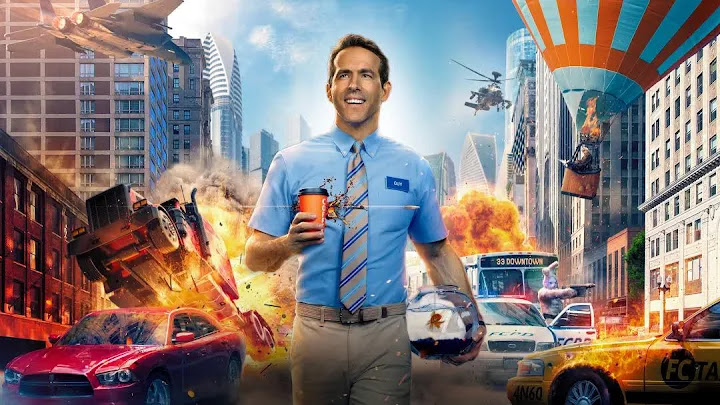
Free Guy (2021).

It's not often that I get a chance to use words like Appearance and Reality around here.  I mean, it's not like I haven't used them in a sentence before on this blog.  If I had to take a bet on it, then my guess is odds are even that I've done just that, sometimes more than once.  However, using those words in the course of an article is not the same as turning to something like a discussion of the topics or ideas contained in each of them.  That's because in some ways a movie like Free Guy can surprise you.  I'll admit, when I saw the first trailers for the film, my initial reaction was to ask myself if I was just looking at maybe another Ready Player One clone.  I've long since made my opinions on that whole debacle known before.  I think that whole movie was such a dispiriting experience, that it at least helps explain the almost immediate skepticism I had to the first preview release of this one.  Instead, I have to ask whether its possible I've been given an opportunity to ponder a few questions related to the perennial struggle between the topics of truth and illusion.  If that sounds like a tall order, or if things seem to be getting "out there" a bit too soon, then perhaps its best to start things out at ground level, and go a bit into the background of today's film.

According to The Hollywood Reporter, the basic concept for the movie began way back in 2016, as an idea in the mind of screenwriter Matt Lieberman.  Here's how the writer described the beginning of things in his own words.  "I’d been a professional screenwriter for a while. I’d sold Christmas Chronicles. I’d worked in the Disney writer’s program for a couple of years, which was great. I’d gotten open writing assignments like Short Circuit and Scoob! Even Addams Family by then. I was definitely feeling a little stuck in a place. It is more an autobiography than I’d be willing to admit. I felt stuck and I had this idea, I’d been kicking it around for a while and I knew it was a good idea. Five years ago this month, I sat down and knocked it out, really quickly".  If there's anything to be frustrated about this information, it's that we're given just the scarcest details as to how the story idea came about.

The good news is the reader doesn't have to go away empty-handed.  Lieberman's admission to an element of autobiography in the story can help give an idea of where it came from.  His comments about feeling "stuck in place" help situate the initial creative idea as stemming from, or growing out of a slight mid-life crisis situation.  It's the sort of thing that can happen if a person starts living life at the rote, just-going-through-the-motions level.  It's a pitfall that anyone can trip into if they're not careful.  This sense of "stuckness" appears to have been the catalyst, allowing the artist's imagination to cough up a story concept which acts as a neat reflection of the writer's circumstance.  Lieberman continues: 

"I wrote the first draft in less than three weeks.  A lot of that stuff is very much still in the movie. It’s crazy.  I’d been kicking around the idea for a while.  I knew what it was.  There were pieces of talent that were interested in talking about it as an idea, as a pitch maybe. I had a good sense of what it needed to be when I started out...I started the idea as, “What if you have the cheat codes to life? What if you could walk around and see power-ups? Oh, then you would be in Grand Theft Auto.” I backed into it that way. Once I had that, it all started falling together really quickly. I relate to NPCs in a lot of ways. Like a lot of writers are, I’m a habitual guy. I’m very much in my lane. My wife says I’m a cartoon character. I wear the same three sets of clothes all the time. The Blue Shirt Guy was me for a while.


"I was thinking a lot about Truman Show and Cabin in the Woods. I’m a high-concept guy. I love great, high-concept movies. I don’t know what they are called in [Cabin in the Woods] — the executive guys. I set it up the same way. Who are these guys? Are the two worlds related? I wanted them to have a scene or two of that where you weren’t even sure if these were part of the same world or not. It just naturally evolved from there (web)".  It's the mention of The Truman Show that gets my attention.  By bringing that film up, Lieberman seems to have provided us with our first clue to the kind of movie he had in mind, even during the course of those first round of drafts.  It's also maybe now that my earlier comment about Appearance and Reality begins to make perhaps the slightest bit of sense.  It's an issue that the Carrey movie is more or less obsessed with from the first reel to the last.  It's also possible that this obsession is part of the reason for why it has stuck around for so long.  There's just something about the conflict or the quest for the reality behind the appearances that is appealing to the human spirit on some fundamental level.  Or at least there's one explanation for it.  Whatever the case, I'd say that's as good a place as any in which to get started on a story born out of one man's mid-life crisis.

Sunday, March 13, 2022

Sonic the Hedgehog (2020).

I guess the best place to start is with a little history.  I born the year George Orwell made famous.  If you stop and do the math here, for a bit, you'll soon discover that means I was more or less just in time for the fallout of the big video game crash of 1983.  It was the start of a pretty lean season for the industry.  The problem, so far as I can tell, was a mixture of market over-saturation, combined with an actual drop in public interest with the digital gaming format.  What it meant in practice was a drop in stock value, and lot of important cash drying up in some otherwise hefty pocket books.  The one blessing visited upon the industry was the 1985 release of a home console cartridge for the Nintendo Entertainment System.  It was an otherwise unassuming piece of work known as Super Mario Bros.  The rest was pretty much history by the time I was old enough to even be aware of any of this.  That game is the one which more or less helped in a slow re-building of enthusiasm for the video game format as a whole.  It became such a juggernaut, that by the time my folks bought me and my sister our first SNES console, it was pretty much a matter of ancient history already.  By the time I came onstage, things had changed for the better.

It was near the end of 1991 that our folks treated us to our own slice of early gamer history when we we're both given our own copy of Super Mario World as a little Christmas bonus to go along with the then new console.  It was the first time I'd ever had any of that stuff in my own living room, and my initial reaction is probably worth being ashamed of now, in the eyes of many who are reading this.  The truth of the matter is my first thought was I didn't even know what the hell I was supposed to do with the darned thing.  The scant amount of exposure I can even remember having to video games up to that point comes in the form of an old episode of Mr. Roger's Neighborhood, of all things.  I guess that's worth a laugh too, as these things go.  No matter how ridiculous it really is, there's nothing that can stop it from being the honest truth.  Kindly, old Fred was paying a visit to a local soda fountain shop, and there, in the corner of the room was this little kid futzing around with this huge box with garish looking colors painted all over the side.  It even had pictures on it, as I recall.  They were of a man, a woman, and an ape, for some reason.  The boy told Fred and the kids at home that the game was called Donkey Kong.  And that was literally all she wrote for me till then on the subject of video games.

Aside from the retrospective recognition that 80s Horror icon Keith David also played a role in that segment, there's very little I can add to a discussion of either the format, or it's history.  Like, seriously, I cannot recall a single minute of my life, from that moment until the winter of 91 when I even so much as heard a single thing about video games.  I'm pretty sure I would have remembered at least something of that, as well, because of the narrower window of information at the public's finger tips.  This was way back before the internet began to pick up any real sense of steam, remember.  We're talking now about the last vestiges of a vanishing Analog Age.  It was a style of living that was already in decline by the time that console was plopped right into the center of the family living room.  However, because the web wouldn't go world wide until a good number of years down the road, that meant there was just one way I could have ever learned of video games, and that was through whatever I managed to catch on the cable TV of that decade.  I was a young strip of a lad, back then, however, and as most hyper-active 80s kids, if it wasn't a cartoon I happened to like, then odds are I tuned it out, more often than not.

I never I even really discovered the 80s music video until some time in the early 2000s.  I would catch some of them at odd moments, and yet the inherent, self-indulgent oddity of the format just worked as a turn-off for me.  These days I'm able to get an ironic sort of enjoyment from a lot of them.  Back then, however, it just wasn't worth my time, or so I thought, anyway.  The point is, if I tuned out one, then I sure as hell probably never paid any attention to a single video game commercial if they were ever advertised on television.  And, like I said, my life up to that point hadn't given me any real disposition to the format.  In fact, I remember I was quite reluctant to even bother with it once it was fully set up.  It came off as noisy, and I wanted to focus on whatever else it was I got in my stockings that year.  I know that must sound like blasphemy to a sizable segment of the readers right now.  You'll just have to take my word that I was a novice at the time, and still remain one to this day, in many ways.


Believe it or not, it was the constant nagging of my parents that finally made me sit down next to my sister on the living room rug, and pick up a console control for the first time.  I think they were operating on the knowledge that they'd forked over a pretty penny for this whole system, and damn it they were not about to let all that lost, hard-earned cash go to waste.  Perhaps the second greatest surprise waiting for me that day was not just that I had a video game in my house, but that after a while, I kinda wound up getting into it a bit.  I found myself in control of everyone's favorite, red and blue wearing plumber, and to be fair, that was the start of a brief yet eventful phase of getting hooked on gaming.  The key word here is that it was just a phase only, and I mean every word of that.  The last video games I ever played were somewhere at or about 2002, just before I was set to graduate high school.  The most interesting thing about my entire experience with gaming is just this.  It was a fun bit of a ride, yet it always seems to have been just a diversion for me.  It never made me into a gamer.

Instead, it seems as if books and films have become the overarching hobbies of my life.  These days, the best I can ever manage in terms of gaming is a peak into the occasional Let's Play video on YouTube, here or there.  Beyond this, I think I never had much to say about video games in general.  That's not the same as saying I don't have a clue as to the impact they've had over the years.  Like, even back when I was still a youngster, I was able to get the sense that big things were happening with the medium.  A lot of this awareness came from starting to notice how a lot of the steam the format was building up made itself felt with a noticeable increase in advertising space.  I almost want to say that Mario World was the game that shifted the paradigm by a lot, because after that, it was like every other commercial on the idiot box was about the latest games.  It wasn't just limited to Nintendo back then, either.  Here's the part where my memory gets sketchy.  I can't tell whether I just heard about the Sega Genesis on TV at some point, and egged my parents to get it, or if that was another Christmas gift.

Come to think of it, did I get Mario World in 91 or 92?  I must have miscalculated.  My first ever copy of a Sega game was Sonic 2, and that wasn't released until 1992, so it must have been the Christmas after that when I got both consoles as gifts.  That's because another piece of memory just occurred, and it insists we got both the SNES and the Genesis together at once.  We made a bigger fuss over the Nintendo, as I recall.  Yet I also just remembered the Genesis was there as well.  I think the fact it didn't occur to me all at once is testament to just which system was prioritized at the time.  As I recollect, it wasn't forgotten, just shunted into second place by everyone that day.  I think I was the one who noticed it left lying around, like an unintentional afterthought.  I'm certain for a fact that it came with the Sonic 2 cartridge, because I still have the image of the eyeless looking Robotnik glaring down at our two heroes.  Anyway, I brought it to my mom's attention, and she helped set it up.  Then I put the cartridge in and started the game up.  That's how I first made acquaintance with the Blue Blur.


Like I said, none of it was ever enough to make me into a full-time gamer.  Though I suppose I spent enough time with either a SNES or Genesis controller in my hand to be able to allow all that stuff to carve out a room full of memories in my brain.  It's by no means the most used, or even well kept room in the place.  It's just something that will probably always be there, in some way.  I know I played Sonic just long enough to get a rough idea of the characters and their personalities.  The main character is the snarky trickster, Tails is the ever-present sidekick, Knuckles is sort of the muscle of the group, and Robotnik (or Eggman, depending on how you choose to call him) is the designated baddie.  Beyond that, I'm not sure how much help I can be.  I just point all this out to give you a heads up.  When it comes to looking at a film adaptation like Sonic the Hedgehog, you might have to accustom yourselves to a very rough outsiders perspective, even if it's the best that I can do, under the circumstances.

Saturday, February 26, 2022

The Collected Short Stories of Philip K. Dick: Roog (1951).

It's one of those images that stays with you.  There's this field, somewhere in the middle of nowhere, USA.  There's not enough detail to tell just where all this takes place, however from the look of the faded, Autumnal orange of the trampled or wild fields of grain or grass that surrounds the main setup on all sides, it looks very much as if we're situated somewhere in or at a cornfield, located somewhere in Nebraska.  It's nighttime outside, and while there aren't that many stars out, one or two can definitely be seen shining above in the night sky.  The field has a plowed up look to it.  It's not the appearance you might associate with the look of scorched earth.  This one is a lot more natural.  You're able to get a sense of tranquility from it.  It takes a while before you mind registers that it's the same type of cultivation that is sometimes used for bits of pasture that have been converted into a baseball field.  There's no Major League quality to be seen anywhere.  This is the sort of ballpark designed so that maybe the neighborhood kids will have someplace to go, or maybe even a dream to shoot for, if the mood is ever right.  There's even some equipment to be seen in the picture, though it's not the stuff you can play a good game with.

Instead, it's a motley assortment of items.  One might even call them somewhat eyebrow raising.  The easiest pieces to discern, the ones closest to the viewer, are one of those old, Red Ryder style firearms, the ones you literally could have just sent for in the mail.  Beside it to the viewer's right is what looks like an oversized Jack-in-the-Box, designed to look something like a pre-schooler's alphabet block.  If the sight of the latched lid of the Box wasn't visible for all to see, we might be wondering what we're looking at.  Located just a foot or two away from the Red Ryder gun is an old library book, one of those, old, faded shelf dwellers with the paper well on its way to becoming parchment with the passing of years.  I can't tell if there's anything on the cover, and that's sort of a shame.  You never know, it could have been a good story.  Located just to the left of the book is a combination football, complete with helmet.  What's notable about it is the headgear looks like the kind they used to have for the game way back before the 1950s or something.  It served its purpose well, and its still so out of date that it almost looks like the sort of thing a space pilot would where in one of those old, cheesy matinee serials.  A few feet further away is what looks like either a bicycle, or some kind of engine device.

All of this is dwarfed, however, by the final prop.  It's the one image that helps define the picture, and let's us know just what it all amounts to.  Situated a few good yards away from all this pop-cultural detritus is the looming figure of a rocket ship.  It's not the viable, scientific, space-worthy type we know from NASA.  This is one of those sleek, dynamic models, the kind you can still find on the covers of old pulp magazines, the type of design you'd find in the work Norman Saunders or Frank R. Paul.  This is the image that adorns the cover of an old, 1995 anthology edited Kim Mohan.  It was called Amazing Stories, as I recall.  This is a picture I ran across some time ago, and it's always managed to stick with me, for some reason.  I guess a lot of it has to do with the way it acts as a neat summation, of sorts.

To me, that picture (illustrated by an artist named Susan Hood, as I later found out) just managed to sum up the nature of Science Fiction to me.  Come to think of it, it probably still does.  What I like about it is that the picture was done by someone who knows there's nothing simple about the genre, not as it stands after the passage of so much history.  That's because of the way history keeps catching up with Sci-Fi.  There is a sense in which it is always out of date, because it deals more in myths, rather than any single scientific fact.  I'm guilty for the sin of trying to pin a label on things, here.  Of trying to to give the category a frame which might take the wind out of its sails.  This is the kind of dirty little secret that's guaranteed to tick off anyone who still hopes for the paradigm where the genre is always trying to stay one step ahead of the technological curve.  This was the ideal that the initial premise of the genre seems to have been based on, and popularized by the likes of John W. Campbell.  For the longest time, you had editors of old pulp magazines proclaiming that what they were publishing amounted to stories about "the World of Tomorrow", in bright, bold letters of glowing neon.

The trouble is that sooner or later the future is always going to catch up with such proclamations, and, yeah, let's just say what's interesting about the way the future was is not so much how it all seems quaint in its plethora of outdated qualities, but rather this lingering sense of naivete about the capabilities of technology, which not even the most persistent of human efforts will likely ever be able to achieve.  In that sense, any remaining zeal for such concepts is probably more of a dinosaur than the old magazine issues in which they originally appeared.  The funny thing is how none of this really seems to bother the silent, yet ever growing number of fans who are willing to flock to these old fancies, now captured forever on yellowing leafs of cheap paper that have still miraculously outlasted all the artists who helped bring it together.  There is a possible sense of glory somewhere in all that.

It's the sort of achievement which I'm willing to bet may even outlast all the various comings and goings of technology as a whole.  For better or worse, this is the Sci-Fi I grew up with.  In a lot of ways, it was sort of right there for me, in at the beginning.  I have a very vivid set of early memories about this.  Part of the reason they are so easy to recall is because they consist, in essence, of a number of well known films.  In chronological order, these are Lawrence of Arabia, Return of the Jedi, Amadeus, and Back to the Future.  These made up my first impressions of the world, the somewhat natural enough result being an outlook that combines a quirky taste for popular entertainment, that is somehow able to exist right alongside a somewhat literate sense of artistic sophistication.  It's weird, in other words, and perhaps not all that common, yet it can still happen, just here and there, is all.  One of the other results of this very young introduction to Science Fiction (from two of its flagship representatives, no less) was the also somewhat natural enough desire to seek out more where that came from.  Here's where I think the limitations of time and place have played a decisive factor in my exposure to the tradition.

My first impressions of Sci-Fi came at a pretty interesting time for the genre.  These days we like to say that Star Wars revitalized things, or broke new ground.  The funny thing is how I was sort of there when this was all happening, and so it's possible for me to tell another story about it.  One that is far different and removed from the standard pop culture narrative, which in itself is probably more of a recent invention, more than it is an established, historical fact.  The truth is that this sense of 80s Sci-Fi and Fantasy as this game-changing juggernaut is a late-come phenomena, at best.  The inevitable result of my generation reaching its brief period of cultural influence, resulting in the still current wave of retro 80s nostalgia on all the major media fronts, with the likes of Stranger Things, and Synthwave music.

What I find interesting about this is how it amounts to a desire for that past, and yet with few exceptions, there's this strange halting quality to the whole thing.  It creates an unintentional sense of irony, when you stop and think about how a natural enough ache for nostalgia has created some less than stellar consequences.  We 80s kids have been given however brief a window of time to demonstrate to the world how much of a Golden Age our pop culture was, or used to be, and yet we seem to have trouble realizing it on various screens, or printed media, for the most part.  This can be seen in the fortunes of the aforementioned Stranger Things, or the recent attempts to revive the Star Wars and Trek franchises.  Sooner or later they reveal that a vital quality has been left out of consideration, and it isn't surprising if the final products have no other choice except to suffer on the crucial artistic level, the one where it counts the most.  If this were just a one thing, then I could always write it off.  The fact that it keeps happening time and again all points to a continuing trend.  What that tells me, in turn, is that there's a sense of imaginative possibilities that's been lost, somehow.


I'm afraid I can't say why this should be the case.  Nor is there any good reason for why these results should be in any way inevitable, except that we choose to let it happen this way.  As I've said already, however, this is all just recent events.  A look back at the way the actual cultural impact of history played out tells a different story.  I should know, because as I said, I was there to see it happen, and it determined the only ways I seemed able to hunt down any more Science Fiction media, if I wanted it.  The truth, as far as I could tell, is that franchises like Star Wars always left a very muted impact once you reached street level.  Stuff like that was left to flicker across the movie or TV screen as far as the adult world was concerned.  Back then, if you wanted more where that came from, you were pretty much on your own.  See, we didn't have anything like a global network of fan communities when I was growing up.  Each Sci-Fi geek, or genre nerd was a collective series of lone voices in the desert.  

The reason for that is pretty simple if you just take a moment to try and remember that there was a time before the internet as we now know it.  In that respect, I'm something of a living artifact.  I have to be one of last remaining fossils of a time gone by.  If you had to give a name for the type of phenomena I represent, then I guess that makes me an Analog Man, or at least a vestige of it.  What it means in practice is that I might have liked Star Wars, and was interested in finding more where that came from, and so I had almost no resources.  There was no real demand for that kind of thing like there is now, and I knew I was just one voice with no real say in the matter.  Instead of the benefits of a time when whole centuries of lost media can be unearthed at the almost literal click of a button, I had to make do with whatever there was on brick and mortar bookstore racks, and anything I might find hanging around an old junk shop.  That's the way the 80s truly was for any devoted pop culture geek.

I grew up in the detritus of a number of eras.  The personal home computer was a relatively new invention that consisted of a black screen with green letters.  Meanwhile, my paternal grandfather was the type who was always on the lookout for a bargain, which means if he had charge of me for a day, then it meant being carted along to old used car lots, or scrap metal dealerships in search of whatever was affordable under Reaganomics.  The result is that my memory is now a collage of assorted bric-a-brac from various, interweaving timelines, the future and the past mingling together for one brief moment of transition before being swept under the rug of history.  In that sense, it was almost like living in a Sci-Fi story.  It was also mainly through this junk shop route that I was able to advance my knowledge of the genre.  What this meant in practice is that before I could ever learn about the future of space fiction, I was more or less stuck having to dig up its past.  This resulted in my making acquaintance with a list of names that I'm pretty mean next to nothing now, and yet the genre wouldn't exist without them.  Some of the names are still relatively well known, such as Arthur C. Clarke.

However, what about someone like Murray Leinster?  Ever heard of him?  How about Clifford Simak, or Hugo Gernsback?  Or what about scientific fantasists like A.E. Van Vogt, Diana Wynn Jones,  C.M. Kornbulth, Margaret St. Clair, James Blish, Eric Frank Russell, Catherine L. Moore, Marjorie Hope Nicolson, Leigh Bracket, or L. Sprague de Camp?  These are the voyagers who made Sci-Fi what it is.  I got to know them all, and they do not deserve to be forgotten.  

Of course its always possible to demand otherwise, this is an observable fact.  Even if Marjorie Nicolson was one of the few women scholars of the 1940s who was not just a writer, but a recognized scholar who did her best to champion the genre to an academic audience way before it was popular.  You do you, however.  The way I got to know the majority of these overlooked names was through the auspices of an antiquated device known as Old Time Radio.  Peter Falk once observed that back before our age, TV was known as books.  It was also sometimes known as the Theater of the Mind, on occasion.  It was what households turned to whenever there was no stack of paper to hand.  For a good chunk of the early 20th century, Dramatic Radio was the closest thing to a national, mass communication.  It's also the other medium, besides books, where I learned about Sci-Fi.

The way it happened for me was through what " has been described as one of the finest offerings of American radio drama and one of the best science fiction series in any medium (web)".  It was a program called X Minus One, and in many ways, I'd still have to call it something of an ideal beginner's course for any young kid who has a burgeoning interest in the Sci-Fi genre.  What makes it such a good starting point is given by the Old Time Radio Plot Spot blog.  It notes that the program was a "direct tie-in with Galaxy magazine, a popular Sci-Fi digest of the period. Most of the stories were culled directly from the pages of Galaxy, or remakes of stories produced for Dimension X (of which X Minus One was originally a revival series). Many of Sci-Fi's most popular authors got mass exposure through this series, and even today X Minus One is still generally considered a cornerstone of radio drama (web)".  The upshot is something of an all-purpose nexus for days of the future past.

At least that's how I got my genre literacy, anyway.  All of this is kind of like stage setting, however.  I've gone into all this history because I felt what was needed more than anything for this post is a sense of the proper context that allows us the best possible doorway into our main subject.  This happens to be another author I discovered through the help of X Minus One.  It was an adaptation of a short story by an author known simply as Philip Kindred Dick.  I'm not here to talk about that radio adaptation.  Though it thought it is good jumping off point to talk about the first story he ever wrote.  Part of the reason for doing this was already explained, in a sense.  Here's the one hard truth I've learned from being a pop-culture junkie all my life.  The dirty little secret is it can only take you so far.  Once you've gone past the point of various trivial facts about the books and movies you enjoy, it's kind of like entering a blank slate space, if that makes any sense.  It's the sort of thing that tends to leave everyone with an empty-handed lack of knowledge that I for one, find downright aggravating.


What it does is leave both artist and audience in the lurch, when I'll swear on a stack of Bibles that there's always more to be uncovered, and that genuine talents shouldn't or can't summarized in the space of a phone tweet.  PKD is one of those Big Names who's suffered from the same flattening effect.  For instance, here's what I mean.  The next paragraph you read will be taken from the Dec. 1st, 2003 issue of a Wired retrospective of the author in question.  "Philip K. Dick liked nothing better than to toy with the fundamentals of human existence, reality chief among them, so what better for the movie than a bullet that may or may not be tearing through the main character's flesh? Like other Dick protagonists – Tom Cruise in Minority Report, Arnold Schwarzenegger in Total Recall, Harrison Ford in Blade Runner– Affleck finds himself struggling for equilibrium in a world where even the most elemental questions are almost impossible to answer. Can the senses be trusted? Are memories real? Is anything real?

"Dick died shortly before Blade Runner's release in 1982, and, despite a cult readership, he spent most of his life in poverty. Yet now, more than two decades later, the future he saw has made him one of the most sought-after writers in Hollywood. Paycheck, based on a 1953 short story Dick sold to a pulp magazine for less than $200, will bring close to $2 million to his estate. And movies based on more than a half-dozen other stories and novels are in the works – among them "The King of the Elves" at Disney, "The Short, Happy Life of the Brown Oxford" at Miramax, and A Scanner Darkly at Warner Bros.

"Dick's anxious surrealism all but defines contemporary Hollywood science fiction and spills over into other kinds of movies as well. His influence is pervasive in The Matrix and its sequels, which present the world we know as nothing more than an information grid; Dick articulated the concept in a 1977 speech in which he posited the existence of multiple realities overlapping the "matrix world" that most of us experience. Vanilla Sky, with its dizzying shifts between fantasy and fact, likewise ventures into a Dickian warp zone, as does Dark City, The Thirteenth Floor, and David Cronenberg's eXistenZ. Memento reprises Dick's memory obsession by focusing on a man whose attempts to avenge his wife's murder are complicated by his inability to remember anything. In The Truman Show, Jim Carrey discovers the life he's living is an illusion, an idea Dick developed in his 1959 novel Time Out of Joint. Next year, Carrey and Kate Winslet will play a couple who have their memories of each other erased in Eternal Sunshine of the Spotless Mind. Memory, paranoia, alternate realities: Dick's themes are everywhere (web)".


This is the reputation that PK has managed to hold onto to this very day.  We'll have a chance to come back to that Wired article.  For right now, all that should be noticed is that while it's far from wrong, like all things associated with pop culture, it can only go so far before losing sight of the rest of the story.  I want to know if there's more to the author than just the troubled paranoiac of popular conception.  The best way I can figure how to do that right now is to start at the beginning, and see what, if anything, it has to tell us about one of the creative minds whose efforts can be said to have gone a long way towards helping to define the possibilities of Science Fiction.  In my mind, at least, that means the best candidate for examination ought to be a simple short story with a very unassuming title.  It's a quick piece known as "Roog", and it first saw light in the 1953 issue of The Magazine of Fantasy and Science Fiction.  As for where the weird sounding title came from, well, you better let me explain.

Sunday, February 13, 2022

The Collected Short Stories of Vladimir Nabokov: La Veneziana (1924).

Mind if I talk about genre for a minute?  I mean those collections of assorted orders and categories that most stories tend to get lumped into, whether written or filmed.  It's a relatively modern innovation, or at least I think it is.  Near as I can tell, the whole thing got started the moment someone noticed that most works of fiction often wound up sharing a lot of similarities when it came to actions, plot beats, or various tropes that still repeat themselves from one narrative to the next.  I think the biggest reason for the creation of the concept, however, was down to just how many stories wind up with this sense of a shared setting, even if they had nothing in common with one another.  What I mean is that if one writer hits upon an idea featuring rocket ships traveling through space, that's not the same thing as claiming that its part of the Star Trek universe, or anything like that.  It is more than possible to create a work of Science Fiction, and let the finished product stand as its own, individual creation.  However, the one thing that Trek and, say, a novel like Frank Herbert's Dune have in common is this shared sense of a generic background.

Most viewer and readers would know that each qualifies as a work of Sci Fi without even having to be told.  It's one of those phenomenon of the artistic life which is so basic at this point that it's almost like breathing oxygen.  It's part of the very air we breath when it comes to art in general.  It's so basic, in fact, that it's only at this late date it occurs to me to realize we haven't given much thought to genre categorizations for quite a while now.  I think the answer her amounts to a matter of practical necessity.  If you come across more than one story featuring the same backdrop setting, that can only mean a small amount of things in terms of shared generic traits.  It's the very proliferation of fictional works set in Outer Space, or the Wild West, which kind of forces the reader's hand, almost by default.  In that regard, it does make sense to argue that genres are just this semi-natural sort of recurring phenomenon, like the turning of the seasons, only some more mysterious for some reason.


If that's the case, then you could say there's not much to complain about or argue over.  It's a sentiment I tend to agree with, in the long run.  I've read from authors who have tried to make the case that sometimes talk of genres can be a writer's worst enemy.  In an introduction to a book called The Rim of Morning, Stephen King claims that when a story is able to grow in importance and impact, it's newfound quality is, or should be, enough to allow it to be able to transcend all talk of mere "genre".  In addition, literary critic Michael H. Means is able to leave us with some interesting food for thought, with an idea he mentions in passing during what is otherwise a straightforward study of medieval texts.

"The term "genre" has fallen somewhat into critical disfavor partly because under the influence of Romanticism we tend to stress the unique nature of each work of literature at the expense of the qualities it shares with similar works.  More seriously, however, the term "genre" is often abused either by using it for the critically arid if pedagogically useful purpose of pigeonholing - disposing of a work by labeling it - or by the very dangerous practice of using genre tags as value judgments, both of which faults are clearly implicit, for example, in the recent controversy over whether Death of a Salesman is or is not a tragedy.  Any attempt to use the concept of literary genres in criticism must start with the recognition of the facts that many, if not most, great works of literature are composed of elements of more than one genre and that good and bad works can be composed of any genre (5-6)".

Here, then, is a pretty good overview of the so called "debate" over the question of genre.  I label it "so called" because to me a phrase by H.G. Wells sums it up.  There can never really be any kind of useful literary war over the concept of genres, "any more than there is a war between men and ants".  The truth is it all just seems to be a part of the natural bells and whistles that go together to make what is known as the artistic life.  It's just a naturally occurring part of the package, in other words.  Something in which none of the parts needed assembling, they just show up sooner or later of their own accord, apparently, more or less.  In that sense, I find myself perfectly at home with genre, while also being able to set it aside, and focus on the individual identity of the artwork in front of me.  It's a topic I can pick up and set down with equal ease, in that regard.  It's also what allows me to even admit that, yes, sometimes it is possible to run across the odd narrative, here and there, that seems to defy categorization.  These are the stories with a foot in several camps, and thus present a challenge.

A good example of what I mean is the very story I'd like to talk about today.  Vladimir Nabokov is one of those writers who wind up gaining their fame through the dubious award of scandal.  When his novel Lolita was published in 1955, there's no way a book like that wasn't going to leave the kind of impact that didn't feel like  punch in the gut.  It was almost guaranteed to receive the sort of backlash, or critical drubbing that was sure to make the rest of the world sit up and take notice, whether it was for the sake of being transgressive in the name of nonconformity, or else just to figure out what the hell all the fuss was about.  The result of such as a literary jolt to the system was predictable enough.  It was certain to etch it's author's byline for all time in the great catalogue of literary names.  It also wound up creating the most ironic pigeonhole for the writer, imaginable.  To this day, there are readers out there who are surprised to discover that someone who could write a book like that proves, on further inspection, to be one of the more saner, seemingly level-headed scribblers out their in the writing trade.

Perhaps the even greater shock is to learn that he had a whole career outside of Lolita, and the Kubrick film that resulted from it.  It turns out Nabokov was one of those "literate" writers whose output is generally considered to be "respectable enough" by the Ivory Tower establishment (or whatever is left of it).  The irony is that this leaves the writer stuck in yet another familiar pigeonhole.  Under this critical-aesthetic lens, Nabokov is seen as something like the final product of the tail-end of the Modernist Movement in 20th century literature.  If poets like T.S. Eliot and Ezra Pound were the opening vanguards of works about the state of man in modern, alienated society, then most tend to believe that Nabokov was somewhere there in at the end, as the grand project in letters came to a close.

It's one of those interesting conclusions, that type which tend to be on the money enough to be labeled as essentially correct, and yet there's always something that's been left out at the same time.  In which case there's very little to be surprised about.  It seems almost like a natural inevitability of literary criticism.  While the big picture is being assembled, the fine details often tend to get lost in the shuffle.  This doesn't necessarily invalidate the big picture as an overall image, though it does tend to leave the final painting somewhat incomplete.  This is something Nabokov would have been happy (perhaps the better term is vehement) to point out to you.  This is true especially when you turn to look at his own opinions on the nature of genre.  He was at least some kind of an expert on this matter.  You don't manage to hold down a career as an English teacher at Cornell University without knowing something of your way around the written word.  That's why, when we turn to one of Nabokov's collected Lectures on Literature, we find him making a very surprising statement about the nature of fiction in general.


During the course of his introductory lecture on English Literature, we find Nabokov confronting us with this very basic claim.  "The truth is that great novels are great fairy tales - and the novels in this series are supreme fairy tales....literature was born on the day when a boy cried wolf...and there was no wolf behind him (xxv-xxvi)".  It's a maxim which he seems to have been contented to live by.  Even his works of fiction display this curious blending of the real and unreal.  A good example of this can be found in one of his earliest short stories, "La Venezianza", and it goes something like this.

Sunday, January 30, 2022

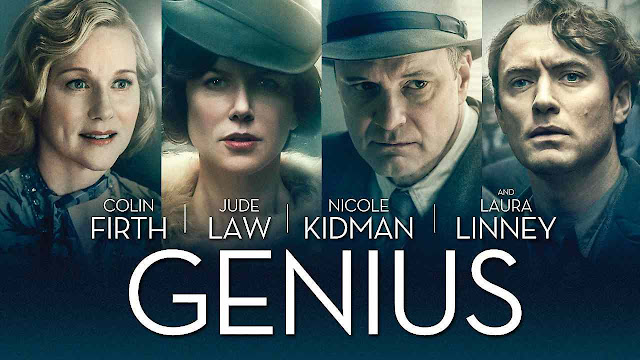
Genius (2016).

This review happened more or less as the result of another.  For a while now, I've had my head filled with images and concepts from the works of Stephen King, Robert Browning, T.S. Eliot, J.R.R. Tolkien, and an Anonymous Storyteller whose name has forever been lost to time.  It was while I was mulling all of this content over that I remembered something.  It turns out that one of the recurrent motifs that King used in composing his famous Dark Tower series was the following quote.  “. . . a stone, a leaf, an unfound door; a stone, a leaf, a door. And of all the forgotten faces (web)".  Tower Junkies will recognize not just the quote, but also the way in which King is able to weave each item listed from that snippet of passage of into the various plot points of his Mid-World saga.  The casual reader, on the other hand, is not going to have much of any clue about what either King, or the quotation itself means.  A few of the fans out there may know that the snippet itself comes from an opening paragraph, which in turn is part of a whole novel.

The trouble here, however, is threefold.  For starters, it's true that attentive fans have been able to spot a legitimate piece of literary allusion, and borrowing.  King really did turn to the work of another author in order to come up with concepts like the Drawing Doors, the Tower Rose, and perhaps even something of the general background of that series main protagonist.  The second issue is where the kick in the teeth comes from.  Even if its true that King used someone else's words to construct his own story, the ironic fact remains that most of his readers don't really have any clue where the quote comes from, or who wrote it.  That brings us to the final challenge.  The name of the author who originated those words, and the work of fiction that they all appeared from.  Whoever it was, he must have been of some importance.  I mean, it obviously impressed King enough to the point where he just felt like he had to use a line from it as a piece of actual, literary world-building.  What does that tell us?


The answer is very little to go on, as it turns out.  The reason why is simple of enough.  How many out there are willing to go the lengths necessary find out where that quote came from, and who its author was?  Who of us out there is willing to be enough of a bookworm to the point of having something like a genuine curiosity about the whole thing?  My guess is that the best possible answer to this question would have to be precious few.  There's never been anything like a functioning, workable culture that encourages that level of literacy as something like a genuine asset.  Luckily, I'm the sort of time-waster who doesn't mind a deep dive into the minutiae of pop-culture, so I thought I'd go ahead and go out on a limb, and have a good old-fashioned book hunt.  The result was that I found what might be called the answer.  Though, in order to tell it, I'm afraid I'll have to go into a bit of literary history.

Saturday, January 15, 2022

The Book of Other Worlds: Childe Rowland (1976).

For some strange reason, it's just been easy for me to compare the two.  For the longest time now, both J.R.R. Tolkien and Stephen King have occupied the same, easy shelf-space in my mind.  The main reason for this seems to be because of how similar they appear, at least as far as my own reading is concerned.  I'm not sure this is a common reaction for most fans of either writer.  However, I do wonder how often this might occur for those Tolkien geeks who are also fans of the Horror genre.  It's just that, for me, I've always been able to see the ways in which Tolkien has impacted King's work to the point where there can be times (especially in his best work) where King almost seems to be copying the old Oxford professor without even trying.  

It's a constant feature of his writing that is perhaps best on display in books like Salem's Lot, The Shining, and It.  When those books reach their peak moments, it's as if King has found a way to turn any given narrative passage of the typical American Gothic setting (such a dry and barren farmer's field, or the inside of a haunted dwelling, or even just a surveyors description of an entire town, or a single corner street in that same setting) into the kind of description that sometimes mirrors, or even rivals any possible segment of Middle Earth and its environs.  I  suppose a better way to put it would be that King has found a way of taking the usual description reserved for Tolkien's Blakean backdrop, and found a way to make it apply to the average, modern suburban American main street.  

Like I say, though, I'm probably going to have to always be in the minority on this reaction.  Even if that's the  case, then I can't say I mind all that much.  Nor do I care to retract that statement.  One of the main reasons why is because I'm sure those readers who do know at least something of what I'm talking about can go through their favorite books in the King canon, and point to any number of passages that would help support this idea.  In the second place, the real good news is that we don't have to just sit around, theorizing in a vacuum.  It turns out the author himself has managed to oblige us on this point.  He does so with the help of a simple essay entitled "On Being Nineteen: (And a Few Other Things)".  If you've never heard of, or even read the piece before, then it's not going to surprise me.  It only appeared in print once a long time ago, and hasn't really been seen since.  In fact, I don't think they include it anymore in the current reprints of the series in which it originally formed a (to me) vital part.

The "Nineteen" essay was originally published to serve as an author's introduction for a 2003 reissue of the first four books in The Dark Tower series.  That's the place where King described a great deal (if perhaps not all) of his relationship to the Bard of Middle Earth.  "Hobbits were big when I was nineteen", he tells us.  "There were probably half-a-dozen Merrys and Pippins slogging through the mud at Max Yasgur's farm during the Great Woodstock Music Festival, twice as many Frodos, and hippie Gandalfs without number.  J.R.R. Tolkien's The Lord of the Ring was madly popular in those days, and while I never made it to Woodstock (say sorry), I suppose I was at least a halfling-hippie.  Enough of one, at any rate, to have read the books and fallen in love with them.  The Dark Tower books, like most long fantasy tales written by men and women of my generation (The Chronicles of Thomas Covenant, by Stephen Donaldson, and The Sword of Shannara, by Terry Brooks, are just two of many), were born out of Tolkien's.

"But although I read the books in 1966 and 1967, I held off writing.  I responded (and with rather touching whole-heartedness) to the sweep of Tolkien's imagination - to the ambition of his story - but I wanted to write my own kind of story, and had I started then, I would have written his.  That, as the late Tricky Dick Nixon was fond of saying, would have been wrong.  Thanks to Mr. Tolkien, the twentieth century had all the elves and wizards it needed.  In 1967, I didn't have any idea what my kind of story might be, but that didn't matter; I felt positive I'd know it when it passed me on the street (ix-x)".   

If nothing else, the existence of these words can serve to establish a number of important facts.  (1) King has been familiar with the work of Tolkien for quite a long time now, even before the advent of the 21st century.  (2) He also acknowledges that the writings of Middle Earth have had quite an impact on his mind, in particular his imagination.  I don't think it's going too far to say that the reaction King got out of the books is pretty the same as that of the entire Woodstock generation of his era.  Besides, all he's doing in the paragraphs above is little more than highlighting a very important historical fact.  It really was during the 1960s that Tolkien's popularity began to take off in a big way.  A lot of it was down to being in the right place at the right time, and a sense of resonant values. The Flower Children of that decade found a sense of common cause with those books.  And I think the real curious part is that their sense of identification was never really misplaced.  What Tolkien and the 60s shared in common was an unapologetic Romantic streak, one that could probably trace its lineage all the way back to the poetry of William Blake, another scribe who found his popularity soaring during those heady years.

It was this shared sense of Romanticism that catapulted Tolkien and his books toward an international stardom that hasn't really gone away since then.  And King was right there when it first happened.  Much like his peers of that time, it's not too much of a leap to say that King found himself caught up in that Romantic ethos, along with everybody else.  He dug it enough, anyway, to get the notion into his head that he ought to try and match a story such as The Lord of the Rings, one that would be just as big, and yet in his own voice.  The question was just what that kind of story would be.  Tolkien supplied the first spark of inspiration, and yet something more was needed.  According to King, that something more came in the form of an old, semi-low-budget Italian film import. 

"Then, in an almost completely empty movie theater (the Bijou, in Bangor, Maine, if it matters), I saw a film directed by Sergio Leone.  It was called The Good, The Bad, and the Ugly, and before the film was even half over, I realized that what I wanted to write was a novel that contained Tolkien's sense of quest and magic but set against Leone's almost absurdly majestic Western backdrop.  If you've only seen this gonzo Western on your television screen, you don't understand what I'm talking about - cry your pardon, but it's true.  On a movie screen, projected through the correct Panavision lenses, TG, TB, & TU is an epic to rival Ben-Hur.  Clint Eastwood appears roughly eighteen feet tall, with each wiry jut of stubble on his cheeks looking roughly the size of a young redwood tree.  The grooves bracketing Lee Van Cleef's mouth are as deep as canyons, and there could be a thinny (see Wizard and Glass) at the bottom of each one.  The desert settings appear to stretch at least out as far as the orbit of the planet Neptune.  And the barrel of each gun looks to be roughly as large as the Holland Tunnel.


"What I wanted even more than the setting was that feeling of epic, apocalyptic size.  The fact that Leone knew jack shit about American geography (according to one of the characters, Chicago is somewhere in the vicinity of Phoenix, Arizona) added to the film's sense of magnificent dislocation.  And in my enthusiasm - the sort only a young person can muster, I think - I wanted to write not just a long book, but the longest popular novel in history.  I didn't succeed in doing that, but I feel I had a decent trip (xiii)".  This is how we got the story known as the Dark Tower series.  The whole thing seems to have been one long strange trip for King.  He claims it all got started in 1966-67, and it didn't stop until roughly 2012.  At least that's as far as his memory could take him at the time he wrote those words.  The catch is that it's not the whole story.  There's still one element, or missing piece of the puzzle, that King has sort of unintentionally neglected.  That's the exact bit of reading he did that seems to have given him the final ingredient needed to set the gears of his imagination into full drive.

This final piece of the puzzle comes in the form of an old, forgotten poem, and it's author.  According to Bev Vincent's book, The Road to the Dark Tower, "Stephen King isn't the first person to write about a man named Roland whose goal was to find and perhaps conquer a mysterious Dark Tower.  He was inspired by the feel of Robert Browning's somewhat obtuse "Childe Roland to the Dark Tower Came", written in Paris on January 2, 1852, during the denouement of Napoleon's coup d'etat.  The poem, which King had been assigned in a class covering the earlier Romantic poets, combines romance and existentialism, atypical of Browning's other work and ahead of its time in its Weltschmerz (281)".

Vincent then goes on to make a very interesting observation.  "Browning, in turn, borrowed his title from a line in Shakespeare's King Lear uttered by Edgar during his mad ravings while disguised as Poor Tom: "Childe Rowland to the Dark Tower came, His word was so still - Fie, foh, and fom/I smell the blood of a British man"...Tom was likely referring to an old Scottish ballad titled "Childe Rowland and Burd Ellen (ibid)".  So what we've been describing and uncovering this whole time amounts to little more than a line of literary descent.  We've been following the circuitous paths and byways of the initial inspirations that King used in constructing the longest story out of his career.  It's the kind of exercise that won't matter to anyone else except English Majors, and King fans.  My only excuse for doing this is because I like stories, and I have a natural curiosity to know where they come from.  If there's a chance that it can help us learn a bit more about King, Browning, the history of the Dark Tower narrative, and what it all means, then it's just the kind of opportunity that I, as a book geek, just can't turn down.

With that said, even those who are be willing to follow me down this particular rabbit hole might look on the whole idea with a more than decent amount of skepticism.  Their question might be whether there is really anything left to know about King's infamous book series, even in terms of its sources?  My answer to this is that there could be at least one avenue that has been left unexplored, and Vincent just told us what it is.  In the passage quoted above, he makes mention of an old ballad known as Childe Rowland.  It's treated as something to be noted in passing, and not given any consideration beyond that point.  I'm starting to wonder if that might have been a mistake, however.  Part of the reason for saying this is because I had a chance to read the actual legend itself.  I came across it in a children's anthology of stories, known as The Hamish Hamilton Book of Other Worlds, edited by Roger Lancelyn Green.  


It's a collection whose purpose is to look at a very specific fictional trope.  A good term of description might be to call it the Other World narrative, or any work of fiction dealing with journeys through through a fantasy reality that is different from, yet somehow connected, or related to ours.  What's interesting is to discover that one of the entries in this collection happened to be the very same legend that Vincent believes might have acted as a direct source for Shakespeare, and later on as an indirect one for both Robert Browning, and Stephen King.  I guess this makes it something of a lucky find.  At least I found it interesting enough to crack open the spine of Green's ancient anthology (the copyright page lists its initial date of publication as 1976 in Great Britain) and see what it has to say.  Who knows?  We might just get lucky and learn a thing or two about, King, Browning, Roland, and the Tower that have often gone overlooked.  "All things serve the Beam", after all.

Sunday, January 2, 2022

The Green Knight (2021).

It's difficult to know where to begin on this one.  There are a number of reasons for that.  Part of it is down the seeming inscrutability of the material under the microscope.  The other lies in the specific type of story we have to deal with.  A better way of putting might be described as the problem of source materials.  The last thing I want to do is turn this into a dry-as-dust- academic study.  I tend to pride myself on making complex literary matters both interesting and graspable for a very large audience.  The real challenge (or one of them, at least) seems to lie in those cases where there really is a lot of material to talk about, so that often you don't know what's the right place to start from.  Right now, I think the best vantage point in which to get our bearings would be to take a survey of the literary landscape before us.  Perhaps that will help us gain something like a usable compass bearing.  A quick enough scan of the territory reveals a familiar setting before our eyes.  It's a field of green underneath, and blue or gray above.  It's also an enchanted forest with a mysterious castle at its heart, or else its the blasted waste land of some long, forgotten field of battle.  The territory seems familiar enough, right down to the knights in shining armor, and the hidden creatures peering at us from the darkness of the trees.  We've been here before.

It could just be that the legends of King Arthur and his Knights present a very special challenge to modern audiences.  I wrote just a moment ago that we've already been through this particular secondary world.  In sense, I guess that statement is true enough.  Or is it?  I mean I don't know about you, it's just that when it comes to Camelot, I've sort of grown up learning all the familiar signposts and benchmarks.  When I was kid, my parents got my one of those quaint, old, clam-shell video cassette copies of The Sword and the Stone, one day.  I can't even recall if it was for a birthday or something like it.  I just know that was my first introduction to the greatest mythical monarch of the British Isles.  Except, or course, we never truly see him in that role for the entirety of the Disney film.  He's only just learning to wear the crown by the time the credits role.  It's also where I first learned about Merlin, the greatest wizard and magical practitioner of all time, as well as the future kingdom itself.

I suppose it's the closest thing anyone will have in terms of a fair to going on decent enough first introduction to the mythos, for better or worse.  From there, what little I've gathered about Arthuriana over the years has been haphazard and slip-shod, probably just like everyone else.  I learned about the Holy Grail, first from Steven Spielberg, and then from Monty Python.  In time I came to know about Malory and Mordred and Morgan Le Fay, and the rise and fall of a great empire, like a hero is supposed to do (or so it's claimed, I have a doubt or two about certain aspects of that trope).  Beyond this, however, I'm not sure that I know any more than anyone else in the audience.  It is just possible that I may have described the constant irony of the Camelot mythos.  It's become one of those ill-defined standbys.  A constant background presence which remains largely unexplored except for the most familiar halls and passageways.  What makes it seem more familiar than it is has to be the fact that it is able to stick in the memory from an early age.  It's enough to lull one into a false sense of security.  You think it's all an open book, when in truth you've barely read little more than a page or two in a much larger story.  I suppose that's just the way it has to be for most folks.  However, I'm not sure it's helpful for a getting a read on a film like The Green Knight.

In the introduction to a Young Adult compendium of the legends, Roger Lancelyn Green provides us with the first hints as to why the terrain of this particular secondary world is more wide, vast, and sometimes a lot more treacherous than we think we know.  "The story of King Arthur and the adventures of his knights have been told so very many times that there seems at first sight little excuse for retelling them yet again.  But, setting aside poetical versions of a variety of the legends made by such poets as Dryden, Morris, Tennyson, Swinburne, and Charles Williams, scarcely any writer in English has done more than condense the narrative of Sir Thomas Malory, cutting and simplifying according to the age of his audience, but always following him with more or less exactitude.  Moreover, it has recently been shown that Malory himself did not write his Book of King Arthur as a single narrative, but merely as a collection of quite separate stories, based on a variety of old French romances.  There is a certain coherence, but no fixed plan (xi)".


It sort of gets worse when you find out about the adventures of a lot of other knights that you really don't know about.  Most of us these days have a sort of passing familiarity with characters like Lancelot, and Galahad.  However, who on earth is Sir Gareth of the Kitchens?  All I know is I'll swear I didn't make that up.  We've heard of figures like Sir Bedivere, yet what is it he did, exactly?  What of Tristan and Isolde?  Who were they?  Here's an even better question.  Who wrote Sir Gawain and the Green Knight?  It isn't until this point is reached that you begin to realize you've maybe stumbled a bit deeper into the forest than you probably meant to go.  Once you step past the well trodden paths, it seems, the risk of getting lost is a bit too easy.  The simple fact is the myth of Arthur and his world is probably deeper and steeper than our current level of pop-cultural awareness can allow.  I think it's this last fact which helps explain the type of reception that's greeted David Lowery's 2021 adaptation of one of the most obscurely famous of the legends of Camelot.  It's sort of all most of us can do to even bother asking the most important question.  Is the story that Lowery has to tell any good?